
How this comes up in practice
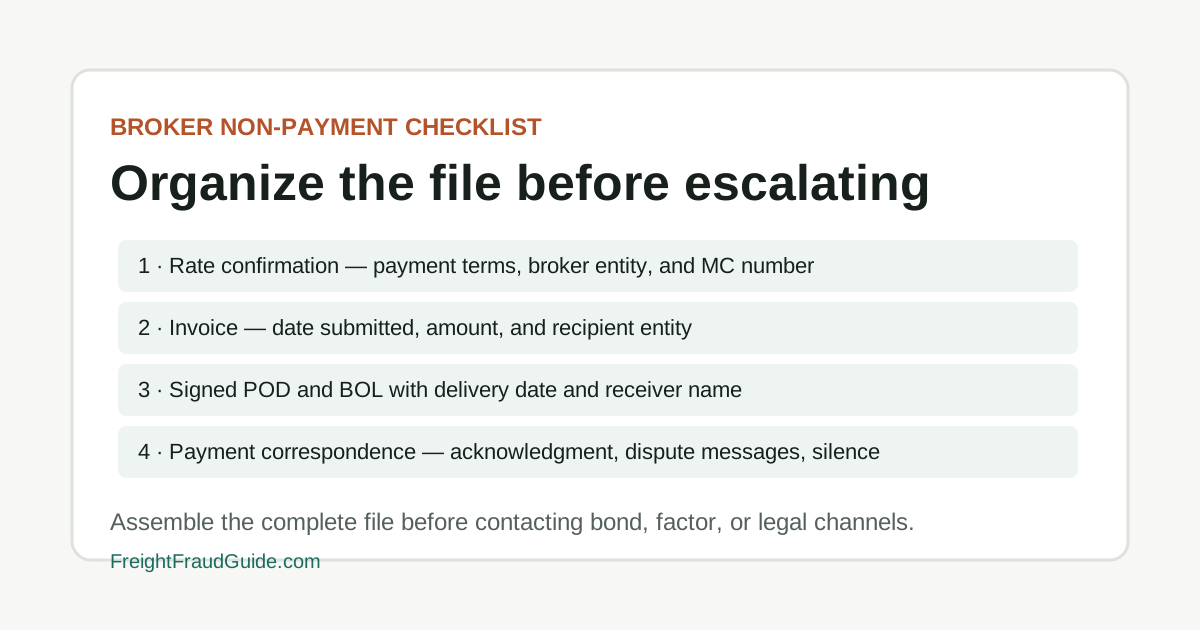
An entity distinction that comes up in non-payment escalations: the broker named on the rate confirmation and the entity appearing in payment emails are different — one an LLC and one an Inc. with similar names. The assumption that they are the same company is often reasonable, but when a dispute moves to the claims stage, the L&I record for the MC number on the rate confirmation may point to a different entity than the one answering payment emails. Organizing the dispute file with a clear separation between the rate confirmation MC number, its corresponding L&I record, and the payment correspondence for each entity is what makes the distinction traceable. Legal and bonding channels typically require that separation documented before a claim can proceed.
The difference between organizing a file and building a useful one
A broker non-payment checklist is an organizing tool, not a legal instrument. What it produces is a file — a clear, dated set of records showing what was agreed, what was delivered, what was invoiced, and what the payment history looks like. That file is what makes the next step, whatever it is, actually workable. For adjacent verification steps, compare this with What to Do If a Broker Does Not Pay, Broker Bond / BMC-84 / BMC-85 Explained, and Factoring NOA Explained.
The distinction between an organized file and a useful one is specificity. Not just 'there's a POD' but 'the POD was received at this facility on this date by this person, and submitted to this contact at the broker by email on this date with a delivery confirmation.' Not just 'the rate confirmation has payment terms' but 'the terms specify 30 days from POD submission, which puts the due date at this specific date.'
Organizing the file with that level of specificity takes more time upfront but produces a file that can be handed to a bond claim process, legal counsel, or a factoring company without requiring further reconstruction. A file that already has the dates, contacts, and amounts clearly established is ready for the next step as soon as it's needed.
Key Takeaways
- Invoice
- POD
- Rate confirmation
- Email proof of submission
- Accessorial approvals
- Broker record
- NOA or remittance instructions
What to establish in the file before escalating
Create a clean aging timeline and match it to the rate confirmation payment terms.
A non-payment checklist should separate missing documents from disputed facts.
What to establish in the file before escalating checklist
- Confirm invoice date.
- Confirm POD submission.
- Check broker entity and remittance path.
Invoice and delivery records to organize
For this workflow, build the file around invoice and pod. Keep the first version separate from later corrections so the sequence remains clear.
Invoice and delivery records to organize checklist
- Invoice
- POD
- Rate confirmation
- Email proof of submission
- Accessorial approvals
- Broker record
- NOA or remittance instructions
Non-payment signals worth investigating
Treat "Invoice sent to wrong entity" as a reason to slow the transaction and document a call-back. It is not, by itself, a public accusation or final finding.
Non-payment signals worth investigating checklist
- Invoice sent to wrong entity
- POD missing or rejected
- Remittance email changed
- Broker says another party owes payment
- Complaint record misunderstood as proof
Questions the non-payment file should answer
Start with the question "What exactly is unpaid?" and tie the answer to a record, known contact, or dated instruction.
Questions the non-payment file should answer checklist
- What exactly is unpaid?
- What document is missing?
- Who disputes the invoice and why?
- Which entity is responsible under the rate confirmation?
Non-payment documentation assumptions to avoid
The main trap here is assuming too much from an incomplete file. In particular: Do not assume all delay is fraud.
Non-payment documentation assumptions to avoid checklist
- Do not assume all delay is fraud.
- Do not assume a complaint database resolves payment.
- Do not assume public posts help preserve legal options.
Official resources for broker payment disputes
Use NCCDB as a comparison point and save the lookup date. Official status can change, and legitimate company records can be impersonated.
Official resources for broker payment disputes checklist
- NCCDB
- How to File a Complaint
- L&I
- NCCDB search limitations
When the file is ready to escalate
Escalate when the file reaches a concrete unresolved point, such as: Documents are complete and payment is overdue. Preserve the evidence and move the question to the right internal, insurance, legal, law-enforcement, or official reporting channel.
When the file is ready to escalate checklist
- Documents are complete and payment is overdue.
- Payment direction dispute exists.
- Bond/trust, legal, or factoring questions arise.
Source Notes
Complaint resources have limits
NCCDB and complaint search resources can inform documentation, but they do not endorse companies or decide private payment disputes for users.
FAQ
What if the broker says the POD was never received?
Send the POD again with delivery confirmation to the exact contact named in the rate confirmation, and document both transmissions. If the broker continues to deny receipt, preserve the full evidence and escalate with dated records.
What's the difference between a disputed invoice and an overdue invoice?
An overdue invoice is past the payment terms date without being contested. A disputed invoice is one the broker is actively contesting — claiming a problem with delivery, load condition, documentation, or charges. Both require documentation, but the next steps differ: overdue moves toward escalation; disputed needs the specific contest identified and documented first.
Should I keep submitting invoices if the broker hasn't paid after multiple attempts?
Send one more with delivery confirmation to the contact named in the rate confirmation, and document that transmission. After that, repeated submissions typically don't advance the situation. Organizing the complete file and considering the appropriate next channel — bond claim, legal, or official complaint — is the more productive step.
Source References
- National Consumer Complaint Database Federal Motor Carrier Safety Administration. primary source. Last checked 2026-05-28. Official FMCSA complaint portal for eligible motor carrier, broker, safety, and registration-related issues.
- Licensing & Insurance Public Federal Motor Carrier Safety Administration. primary source. Last checked 2026-06-02. Official public portal for authority, insurance, and broker financial responsibility records.
- How to File a Complaint Federal Motor Carrier Safety Administration. primary source. Last checked 2026-05-28. FMCSA complaint filing guide for NCCDB. Includes emergency boundary language.
- NCCDB Complaint Search Database Federal Motor Carrier Safety Administration. primary source. Last checked 2026-05-28. NCCDB search page includes important non-endorsement and reliance limitations.