
How this comes up in practice
A packet that looks complete can still contain details a consistent line-by-line review would surface. One that comes up during certificate review: an insurance certificate lists an issuer phone number that connects to voicemail under a generic greeting rather than a named insurance company, and the certificate holder field is blank. Neither detail prevents the packet from looking complete on a quick pass. What catches both is reviewing the certificate in a fixed sequence — entity name, policy dates, coverage description, certificate holder, issuer contact — rather than treating a polished format as a signal that the underlying details check out. A certificate whose issuer cannot be confirmed through an independently verified contact has not been confirmed.
Why a complete-looking packet isn't a complete verification
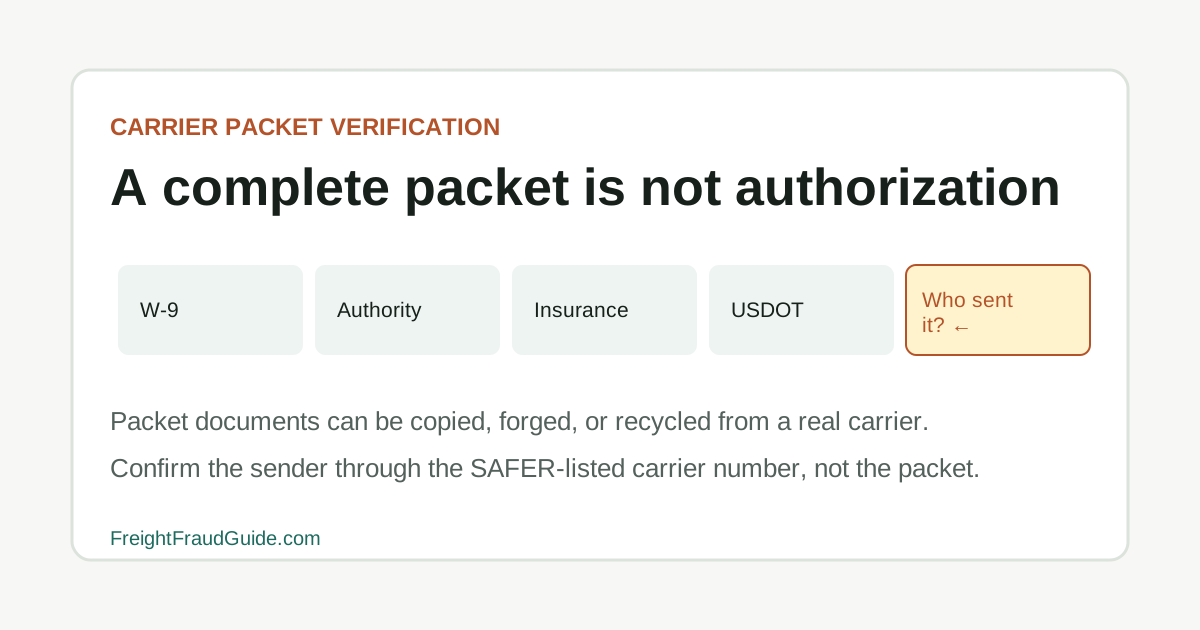
A carrier packet serves one specific function: it establishes a set of baseline documents for an entity. It doesn't certify that the entity submitting the packet is authorized for any specific load, that the documents are current, or that the issuing parties behind each document are reachable and would confirm what the documents say. For adjacent verification steps, compare this with How to Verify a Motor Carrier, and New Authority Risk Signals.
The gap between 'packet received' and 'carrier verified' is where most carrier fraud events occur. A packet can be copied from a legitimate carrier, assembled from publicly available information, or produced well enough to pass a visual review. The individual documents — W-9, insurance certificate, operating authority record — each require a separate confirmation that goes outside the packet itself.
Certificate issuer confirmation, a SAFER callback to the carrier's management, and payment direction verification through the carrier are the steps that complete what the packet starts. Treating a packet as final verification is a gap that recurs in carrier onboarding — and it is the gap carrier identity fraud is built to exploit.
Key Takeaways
- W-9
- Certificate of insurance
- Operating authority record
- Safety rating check
- NOA if applicable
- Signed broker-carrier agreement
- Emergency contact
What to review in a carrier packet
Review the packet as a set of records, not a stack of isolated PDFs.
The packet should match the carrier identity that will arrive at pickup.
What to review in a carrier packet checklist
- Check W-9 and legal name.
- Verify insurance details.
- Confirm dispatcher and emergency contacts.
Packet documents to organize and verify
For this workflow, build the file around w-9 and certificate of insurance. Keep the first version separate from later corrections so the sequence remains clear.
Packet documents to organize and verify checklist
- W-9
- Certificate of insurance
- Operating authority record
- Safety rating check
- NOA if applicable
- Signed broker-carrier agreement
- Emergency contact
Packet signals worth a follow-up call
Treat "Legal names differ across forms" as a reason to slow the transaction and document a call-back. It is not, by itself, a public accusation or final finding.
Packet signals worth a follow-up call checklist
- Legal names differ across forms
- Insurance certificate issuer contact looks altered
- NOA conflicts with payment instructions
- Agreement is unsigned
- Emergency contact cannot identify the load
Questions a carrier packet should answer
Start with the question "Which legal entity is contracting?" and tie the answer to a record, known contact, or dated instruction.
Questions a carrier packet should answer checklist
- Which legal entity is contracting?
- Who issued the certificate?
- Who can verify dispatch authorization?
- What payment direction is current?
What a complete packet doesn't confirm
The main trap here is assuming too much from an incomplete file. In particular: Do not assume a complete packet is accurate.
What a complete packet doesn't confirm checklist
- Do not assume a complete packet is accurate.
- Do not assume a screenshot is an official record.
- Do not assume a factoring notice is valid without contact verification.
Official records to compare against the packet
Use SAFER as a comparison point and save the lookup date. Official status can change, and legitimate company records can be impersonated.
Official records to compare against the packet checklist
- SAFER
- L&I
- FMCSA insurance filing requirements
When packet discrepancies require escalation
Escalate when the file reaches a concrete unresolved point, such as: Insurance cannot be confirmed. Preserve the evidence and move the question to the right internal, insurance, legal, law-enforcement, or official reporting channel.
When packet discrepancies require escalation checklist
- Insurance cannot be confirmed.
- Packet entity and truck at pickup differ.
- Payment direction conflicts with NOA or agreement.
Source Notes
Packet documents are only one layer
A packet should be reconciled against official status, insurance, contacts, payment instructions, and dispatch authorization.
FAQ
If a carrier's packet matches SAFER, is onboarding complete?
Packet review is one layer, not the complete process. A packet that matches SAFER for legal name and address still does not confirm that the dispatcher contacting you is authorized by that company. Complete onboarding includes confirming a direct contact with carrier management.
How should I verify an insurance certificate's issuer phone number if I can't trust the number on the certificate?
Find the insurer's contact through an independent source — the insurance company's official website or a general business directory — before calling. A potentially forged certificate may contain a phone number that routes to whoever created the document. An independently found contact removes that risk.
What does a signed broker-carrier agreement actually prove?
It establishes the agreed terms between the broker entity and the carrier entity named in it at the time of signing. It doesn't prove that the person who signed was authorized to sign for that entity, or that the carrier named in it will be the one arriving at pickup. It's one layer in a multi-step verification process, not a substitute for the other layers.
Source References
- SAFER Company Snapshot Federal Motor Carrier Safety Administration. primary source. Last checked 2026-06-03. Official Company Snapshot lookup. Treat as a current record check, not a guarantee of transaction authority.
- Licensing & Insurance Public Federal Motor Carrier Safety Administration. primary source. Last checked 2026-06-02. Official public portal for authority, insurance, and broker financial responsibility records.
- Insurance Filing Requirements Federal Motor Carrier Safety Administration. primary source. Last checked 2026-06-02. Official FMCSA insurance and financial responsibility filing page. Recheck for Motus-related filing changes.
- Broker and Carrier Fraud and Identity Theft Federal Motor Carrier Safety Administration. primary source. Last checked 2026-06-01. FMCSA guidance on broker and carrier fraud, unauthorized USDOT use, suspicious links, SAFER phone comparison, NCCDB, OIG, FTC, and IC3 reporting pointers.