
How this comes up in practice
A load departs on a Thursday afternoon for a two-day transit. The broker has the carrier's dispatcher number from the packet. On Friday morning, tracking shows the trailer stationary at a truck stop off the route for four hours. The broker calls the dispatcher number from the packet, which goes to voicemail. An hour later the dispatcher calls back and says the driver stopped to rest — no location detail, no estimated departure time. The broker accepts the explanation. On Saturday, when the freight doesn't arrive by the delivery appointment, the broker calls again and gets no answer. The carrier's SAFER-listed number, reached late Saturday afternoon, connects to management who confirms the driver picked up the load but has had no contact with them since Friday morning. What had never been established before the load departed was a planned check-in window, a secondary contact at the carrier's main office separate from the dispatcher, and a clear escalation path when a stop window was exceeded. The tracking system showed the problem on Friday morning. The contact structure wasn't in place to act on it.
Why tracking data requires a contact protocol to be actionable
Tracking visibility and load security are not the same thing. Knowing where a trailer is doesn't automatically produce any action — it becomes useful only when the people responsible for the load have an established process for what to do when the trailer appears somewhere unexpected. A tracking alert that goes to a dispatcher who doesn't respond, or that triggers a call to a number that routes to voicemail, produces information without a path forward. For adjacent verification steps, compare this with High-Risk Freight Types, What to Do After Cargo Theft, and Seal Number Checklist.
The contact protocol that makes tracking actionable has specific components: a planned check-in interval matched to the freight type and transit time, a carrier contact that goes to management rather than only the dispatcher's mobile number, and a defined escalation path when the check-in isn't made. That path ends at the carrier's main office — reachable through SAFER — and then at the shipper, insurer, and law enforcement if the situation warrants it.
What load tracking can and can't establish matters for incident documentation. A tracking record showing a trailer stationary at an unexpected location, combined with timestamped records of when contact was attempted and what each attempt produced, creates an incident timeline that insurers and law enforcement can use. A tracking history with no corresponding contact record establishes location data but not what was done with it — a gap in the incident file, not just in the security procedure.
Key Takeaways
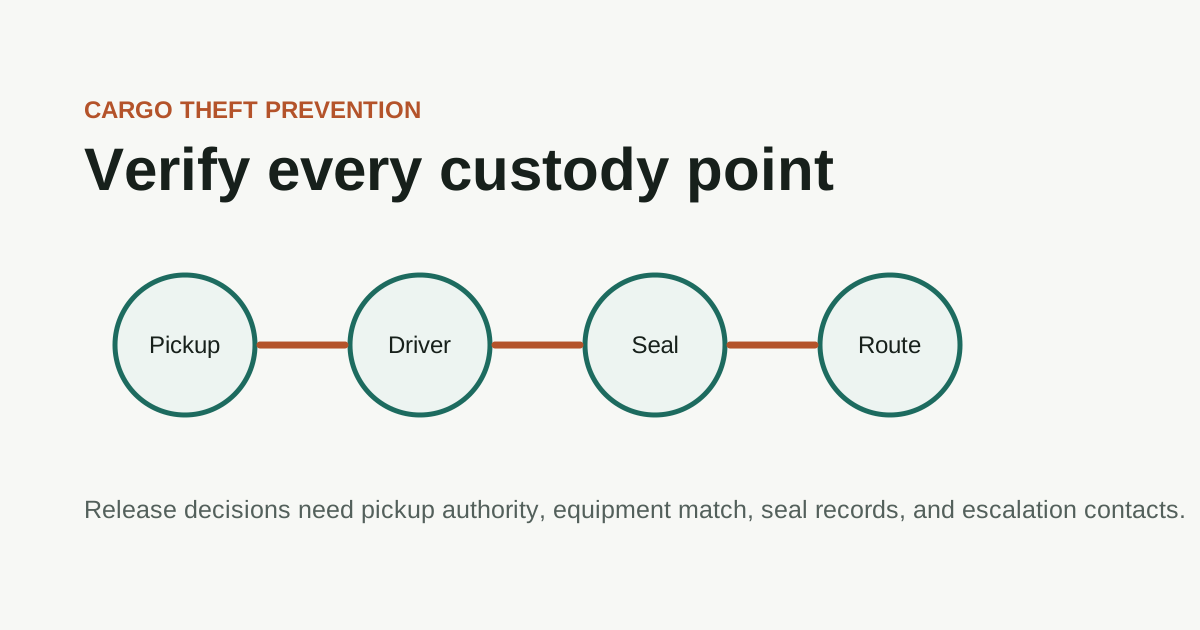
- Verify the driver, carrier, truck, trailer, and pickup number before releasing freight.
- Record seal numbers and exceptions at pickup, transfer points, and delivery.
- Use planned communication and stop procedures for sensitive freight.
- Escalate immediately when contact details, routing, or delivery instructions change unexpectedly.
How tracking expectations fit into a cargo security workflow
GPS tracking provides a data trail but doesn't stop theft in progress. Its value is in creating an early-warning signal when load position becomes unreachable or deviates from the planned route, and in building a timestamped record usable after the fact. The operational question is what happens when tracking shows an unexpected stop or loss of signal — and whether the process for responding to that was written down before the load departed.
Tracking is most useful when expectations are set in writing before departure: check-in intervals, permitted stop locations, and who to contact when the load goes silent. A driver who knows check-in is expected at specific intervals is less likely to deviate without notice; a dispatcher with a clear escalation protocol responds faster when a deviation occurs.
How tracking expectations fit into a cargo security workflow checklist
- Whether tracking expectations — check-in intervals, permitted stops — are in writing before the load departs
- Whether the carrier's driver or dispatcher has confirmed they will follow the check-in schedule
- Whether there is a designated contact on both sides for out-of-hours tracking issues
- Whether a routing deviation or loss of contact triggers a defined escalation process
- Whether tracking data is preserved as part of the load file for potential use in a dispute or claim
Records to check at each custody point
Cargo theft prevention ties identity checks to custody points: pickup, stops, seal changes, route exceptions, and delivery. In this guide, that starts with tracking expectations, contact cadence, planned stops, geofence exceptions, and recordkeeping.
The file should show not only who was assigned, but who actually took control of the freight and under what release instruction. Keep the question practical: what changed, who introduced it, and which dated record can be saved before anyone acts on it.
Records to check at each custody point checklist
- Verify the driver, carrier, truck, trailer, and pickup number before releasing freight.
- Record seal numbers and exceptions at pickup, transfer points, and delivery.
- Use planned communication and stop procedures for sensitive freight.
- Escalate immediately when contact details, routing, or delivery instructions change unexpectedly.
What the custody record can show
For gps tracking and load security basics, the useful record is usually the one that shows where tracking expectations, contact cadence, planned stops, geofence exceptions, and recordkeeping first entered the file.
That record is stronger when it sits beside the dated lookup, the original message, and a note from the shipper, warehouse, broker, or carrier security contact. It is weaker when it has been renamed, cropped, forwarded without headers, or separated from the transaction timeline.
What the custody record can show checklist
- Record the name, number, document field, contact path, or instruction tied to tracking expectations, contact cadence, planned stops, geofence exceptions, and recordkeeping.
- Keep the original file or message before saving a marked-up copy.
- Add the source URL, access date, sender identity, and who confirmed or contradicted the detail.
When release or transit should pause
Hold the pickup, release, route, or incident-response decision when the file depends on a new contact path, revised document, missing official record, or mismatch that no one has explained.
The pause should be narrow and written down: the field that does not line up, the source used to check it, and the person or channel that must answer before the work continues.
When release or transit should pause checklist
- Name the exact field or instruction that does not line up.
- Save the document version or message that introduced the mismatch.
- Check the official or independently known source before using the new detail.
- Record the confirmation result before continuing.
What to document through the transit
Preserve custody records close to the event, while pickup staff, dispatch, and tracking contacts still have fresh details. In this guide, that starts with tracking expectations, contact cadence, planned stops, geofence exceptions, and recordkeeping.
For sensitive freight, communication records and route exceptions can be as important as the BOL. Keep the question practical: what changed, who introduced it, and which dated record can be saved before anyone acts on it.
What to document through the transit checklist
- Pickup authorization and pickup number
- Driver, truck, trailer, and carrier assignment
- BOL, seal record, and route notes
- Tracking gaps or stop exceptions
- Delivery confirmation and shortage or damage notes
Questions to ask at pickup and delivery
Cargo questions should confirm that the release instruction, carrier identity, driver, and equipment all match before freight leaves the facility. In this guide, that starts with tracking expectations, contact cadence, planned stops, geofence exceptions, and recordkeeping.
If something changes in transit, the contact path should already be written down. Keep the question practical: what changed, who introduced it, and which dated record can be saved before anyone acts on it.
Questions to ask at pickup and delivery checklist
- Who authorized release at pickup?
- Does the driver and equipment match the confirmed assignment?
- What stops or route exceptions are permitted?
- Who responds if tracking goes silent?
Assumptions that reduce theft prevention
Theft prevention weakens when teams treat pickup as the final verification point. Identity and custody checks need to continue through transit. In this guide, that starts with tracking expectations, contact cadence, planned stops, geofence exceptions, and recordkeeping.
A tracking dot without a response protocol is only a record; it is not a security process. Keep the question practical: what changed, who introduced it, and which dated record can be saved before anyone acts on it.
Assumptions that reduce theft prevention checklist
- Do not assume a pickup number proves authorization.
- Do not assume tracking prevents theft by itself.
- Do not ignore seal or route exceptions.
- Do not wait until delivery to investigate a contact gap.
When to escalate a theft concern
Escalate quickly when freight, identity, route, or contact details deviate from the confirmed plan. In this guide, that starts with tracking expectations, contact cadence, planned stops, geofence exceptions, and recordkeeping.
A theft concern may require internal security, carrier management, shipper notice, insurer contact, law enforcement, or IC3 when cyber-enabled activity is involved. Keep the question practical: what changed, who introduced it, and which dated record can be saved before anyone acts on it.
When to escalate a theft concern checklist
- A different driver or equipment arrives.
- Seal, route, or stop details do not match the plan.
- Tracking goes silent outside the agreed window.
- The load is missing, diverted, or released under disputed authority.
Source Notes
Source context for GPS Tracking and Load Security Basics
For cargo theft topics, FBI cargo theft reporting and FMCSA fraud guidance are the primary federal sources. FBI IC3 handles cyber-enabled theft incidents including account takeovers that lead to fictitious pickups. FMCSA fraud guidance addresses fictitious pickup and identity-based cargo theft patterns. Law enforcement and insurers are the primary action channels for active cargo theft situations.
FAQ
What should I do if tracking stops showing the load's location mid-transit?
Follow the escalation process established before the load departed. Attempt contact with the driver and dispatcher through known lines. If neither responds within the expected window, escalate internally and contact carrier management. Preserve all tracking data and communication attempts with timestamps.
What's the right check-in frequency for a standard dry van load?
The specific frequency depends on the load, commodity, lane, and any shipper or contract requirements. For sensitive freight, check-ins short enough to detect a meaningful deviation before it becomes a loss are appropriate. The frequency should be established before the load departs and agreed on by the driver — not improvised after departure.
How long should I wait before escalating when tracking goes silent?
Follow the escalation protocol established before the load departed. If one wasn't set, contact the driver and dispatcher simultaneously through known lines when tracking goes silent. If neither responds within a reasonable window tied to the check-in interval, escalate to carrier management and start documenting each attempt with a timestamp. Don't wait until the scheduled delivery window to act on a tracking gap.
Source References
- Cargo Theft Federal Bureau of Investigation. primary source. Last checked 2026-05-15. FBI overview of cargo theft, including strategic theft trends such as identity theft, fictitious pickup, account takeover, double brokering scams, and fraudulent carriers.
- Broker and Carrier Fraud and Identity Theft Federal Motor Carrier Safety Administration. primary source. Last checked 2026-06-01. FMCSA guidance on broker and carrier fraud, unauthorized USDOT use, suspicious links, SAFER phone comparison, NCCDB, OIG, FTC, and IC3 reporting pointers.