
How this comes up in practice
A cargo claim dispute over temperature-sensitive freight came down to a single missing notation. The carrier had applied a seal at the shipper, written the number on the BOL header, and photographed the sealed trailer before departure. At the receiving facility, the receiver opened the trailer and found damage before anyone recorded the seal condition on arrival. The carrier's position was that the trailer had been properly sealed and maintained throughout transit; the receiver's position was that they had no record of what the seal looked like before they opened it. Both accounts were documented in writing. What was missing was the delivery-side seal record: the number confirmed and noted before the trailer was opened, with the receiver's initials. That comparison — seal at pickup against seal at delivery — would have established either an unbroken chain or a specific point of exception. Without the delivery notation, the dispute had two consistent but incompatible accounts and no document to settle them.
What seal records establish and where the chain breaks
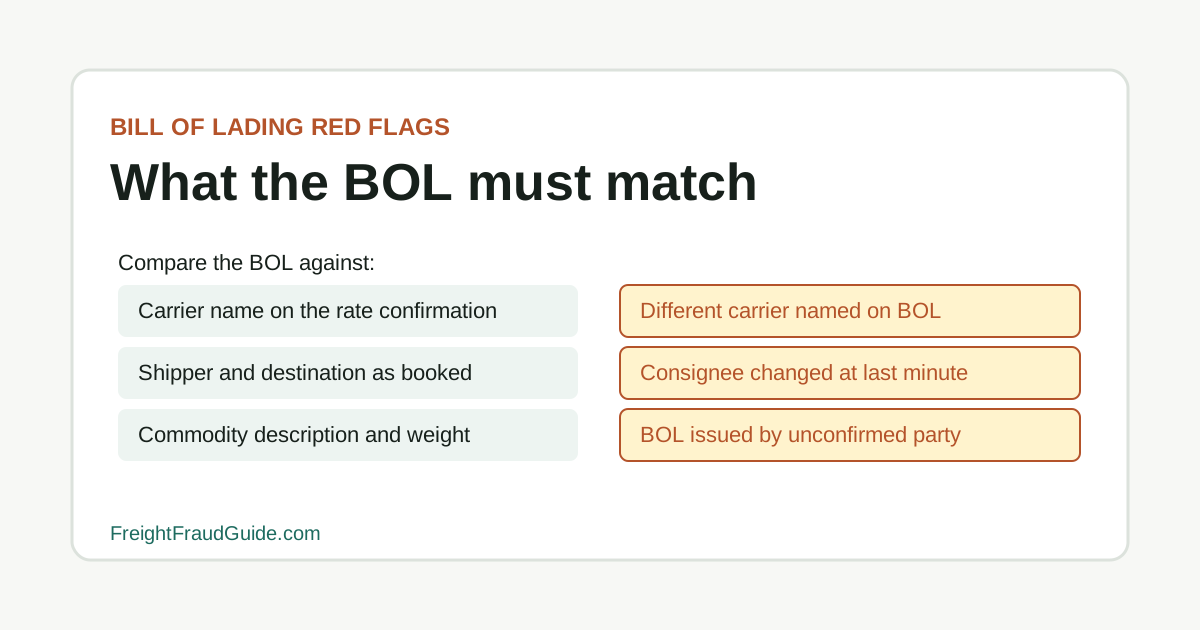
A seal number's value in a freight transaction is proportional to the consistency with which it's recorded across custody points. A seal noted at the shipper, confirmed on the BOL, and compared at delivery creates a complete custody record for that container. Any break in that chain creates a dispute window — a period during transit where an exception could have occurred without documentation. For adjacent verification steps, compare this with Bill of Lading Red Flags, Cargo Theft Prevention Checklist, and GPS Tracking and Load Security Basics.
Seal records matter most in two situations: cargo claims, where the seal condition at delivery helps establish whether damage happened in transit or at the receiving facility; and theft incidents, where a seal on the BOL that doesn't match what arrived may indicate unauthorized access during transport. In both cases, the value of the seal record depends entirely on whether it was captured consistently.
The chain breaks at the delivery end when receivers open the trailer before recording the arriving seal number and its condition. If that notation isn't made before the trailer is opened, the opportunity to establish the arrival state is gone. A seal record at pickup without a corresponding record at delivery doesn't create the chain — it only establishes one end of it.
Key Takeaways
- Verify the driver, carrier, truck, trailer, and pickup number before releasing freight.
- Record seal numbers and exceptions at pickup, transfer points, and delivery.
- Use planned communication and stop procedures for sensitive freight.
- Escalate immediately when contact details, routing, or delivery instructions change unexpectedly.
Recording seal numbers consistently through the transit chain
A seal number is only meaningful if it was recorded consistently at every custody point. The seal applied at the shipper needs to match what's on the BOL, what the driver confirms at pickup, and what the receiver records at delivery. A break in that chain — a different number, a missing notation, a seal that can't be located — is a documented exception that matters for cargo claims and transit disputes.
When in-transit tampering is disputed, the seal record is what the review turns on. A seal number recorded on the BOL and confirmed at delivery puts any exception in writing at the right time. Without that record, the question of when a discrepancy occurred becomes very difficult to answer.
Recording seal numbers consistently through the transit chain checklist
- Whether the seal number was recorded on the BOL at pickup and confirmed by the driver
- Whether photos of the seal were taken where the shipper's policy permits, before the trailer departed
- Whether any intermediate transfer points have seal confirmation in their handoff records
- Whether the receiver recorded the seal number on arrival before opening the trailer
- Whether any seal exception — broken, missing, or different number — was noted and communicated before or at delivery
Records to check at each custody point
Cargo theft prevention ties identity checks to custody points: pickup, stops, seal changes, route exceptions, and delivery. In this guide, that starts with seal issue, photos where permitted, BOL notation, delivery comparison, and exception notes.
The file should show not only who was assigned, but who actually took control of the freight and under what release instruction. Keep the question practical: what changed, who introduced it, and which dated record can be saved before anyone acts on it.
Records to check at each custody point checklist
- Verify the driver, carrier, truck, trailer, and pickup number before releasing freight.
- Record seal numbers and exceptions at pickup, transfer points, and delivery.
- Use planned communication and stop procedures for sensitive freight.
- Escalate immediately when contact details, routing, or delivery instructions change unexpectedly.
What the custody record can show
For seal number checklist, the useful record is usually the one that shows where seal issue, photos where permitted, BOL notation, delivery comparison, and exception notes first entered the file.
That record is stronger when it sits beside the dated lookup, the original message, and a note from the shipper, warehouse, broker, or carrier security contact. It is weaker when it has been renamed, cropped, forwarded without headers, or separated from the transaction timeline.
What the custody record can show checklist
- Record the name, number, document field, contact path, or instruction tied to seal issue, photos where permitted, BOL notation, delivery comparison, and exception notes.
- Keep the original file or message before saving a marked-up copy.
- Add the source URL, access date, sender identity, and who confirmed or contradicted the detail.
When release or transit should pause
Hold the pickup, release, route, or incident-response decision when the file depends on a new contact path, revised document, missing official record, or mismatch that no one has explained.
The pause should be narrow and written down: the field that does not line up, the source used to check it, and the person or channel that must answer before the work continues.
When release or transit should pause checklist
- Name the exact field or instruction that does not line up.
- Save the document version or message that introduced the mismatch.
- Check the official or independently known source before using the new detail.
- Record the confirmation result before continuing.
What to document through the transit
Preserve custody records close to the event, while pickup staff, dispatch, and tracking contacts still have fresh details. In this guide, that starts with seal issue, photos where permitted, BOL notation, delivery comparison, and exception notes.
For sensitive freight, communication records and route exceptions can be as important as the BOL. Keep the question practical: what changed, who introduced it, and which dated record can be saved before anyone acts on it.
What to document through the transit checklist
- Pickup authorization and pickup number
- Driver, truck, trailer, and carrier assignment
- BOL, seal record, and route notes
- Tracking gaps or stop exceptions
- Delivery confirmation and shortage or damage notes
Questions to ask at pickup and delivery
Cargo questions should confirm that the release instruction, carrier identity, driver, and equipment all match before freight leaves the facility. In this guide, that starts with seal issue, photos where permitted, BOL notation, delivery comparison, and exception notes.
If something changes in transit, the contact path should already be written down. Keep the question practical: what changed, who introduced it, and which dated record can be saved before anyone acts on it.
Questions to ask at pickup and delivery checklist
- Who authorized release at pickup?
- Does the driver and equipment match the confirmed assignment?
- What stops or route exceptions are permitted?
- Who responds if tracking goes silent?
Assumptions that reduce theft prevention
Theft prevention weakens when teams treat pickup as the final verification point. Identity and custody checks need to continue through transit. In this guide, that starts with seal issue, photos where permitted, BOL notation, delivery comparison, and exception notes.
A tracking dot without a response protocol is only a record; it is not a security process. Keep the question practical: what changed, who introduced it, and which dated record can be saved before anyone acts on it.
Assumptions that reduce theft prevention checklist
- Do not assume a pickup number proves authorization.
- Do not assume tracking prevents theft by itself.
- Do not ignore seal or route exceptions.
- Do not wait until delivery to investigate a contact gap.
When to escalate a theft concern
Escalate quickly when freight, identity, route, or contact details deviate from the confirmed plan. In this guide, that starts with seal issue, photos where permitted, BOL notation, delivery comparison, and exception notes.
A theft concern may require internal security, carrier management, shipper notice, insurer contact, law enforcement, or IC3 when cyber-enabled activity is involved. Keep the question practical: what changed, who introduced it, and which dated record can be saved before anyone acts on it.
When to escalate a theft concern checklist
- A different driver or equipment arrives.
- Seal, route, or stop details do not match the plan.
- Tracking goes silent outside the agreed window.
- The load is missing, diverted, or released under disputed authority.
Source Notes
Source context for Seal Number Checklist
For cargo theft topics, FBI cargo theft reporting and FMCSA fraud guidance are the primary federal sources. FBI IC3 handles cyber-enabled theft incidents including account takeovers that lead to fictitious pickups. FMCSA fraud guidance addresses fictitious pickup and identity-based cargo theft patterns. Law enforcement and insurers are the primary action channels for active cargo theft situations.
FAQ
If a seal is broken at delivery but the driver says it was already broken at pickup, how do I document that?
The time to document seal condition is at pickup, not delivery. If no exception was noted at pickup and the seal is broken on arrival, treat it as an in-transit exception. Note the condition, delivery timestamp, and driver's statement, and file an exception before signing the delivery receipt.
What if the shipper doesn't have a seal available at pickup?
Record the absence of a seal on the BOL at pickup and note it in the load file. The absence is a documented exception, not typically a reason to refuse pickup — but it establishes that any seal discrepancy at delivery existed from the start. Don't notate a seal as applied if it wasn't.
Does a photograph of a seal replace the written seal number record?
A photo supplements the record; it doesn't replace it. The photo shows the seal's condition at a specific point in time. The seal number — recorded on the BOL and in the load file — is what connects the photo to the custody event and allows comparison across pickup, transit, and delivery. Both together are stronger than either alone.
Source References
- Cargo Theft Federal Bureau of Investigation. primary source. Last checked 2026-05-15. FBI overview of cargo theft, including strategic theft trends such as identity theft, fictitious pickup, account takeover, double brokering scams, and fraudulent carriers.
- Broker and Carrier Fraud and Identity Theft Federal Motor Carrier Safety Administration. primary source. Last checked 2026-06-01. FMCSA guidance on broker and carrier fraud, unauthorized USDOT use, suspicious links, SAFER phone comparison, NCCDB, OIG, FTC, and IC3 reporting pointers.