
How this comes up in practice
A broker the carrier has worked with twice before sends a quick-pay offer two days after delivery confirmation. The rate was $1,800; the net after the fee would be $1,620. The message uses the broker's company name and format, arriving in the same email thread as earlier load communication. The sending domain, on close inspection, differs by one character from the broker's actual address — a letter transposed in the middle of a longer company name. The payment portal in the message asks the carrier to re-enter banking details to receive the accelerated payment. The carrier enters the information. The real broker's accounting department, reached a week later when regular payment didn't arrive, has no record of the quick-pay offer. The combination — a payment shortcut arriving through a slightly different domain, requesting banking detail re-entry, with a clear financial incentive — follows a pattern documented in business email compromise reporting. The check: a call to the broker's main accounting line, through a number confirmed from a prior transaction or from L&I, before entering any banking information.
Why quick-pay instructions concentrate payment fraud risk
Quick-pay arrangements trade payment timing for cost: the carrier accepts a discount in exchange for faster settlement. That structure builds urgency into the transaction — carriers want the funds quickly, brokers are incentivized to offer the option, and the verification steps that apply to standard payment instructions can feel like friction against a benefit. That friction is what payment fraud targeting quick-pay exploits. For adjacent verification steps, compare this with Factoring NOA Explained, Broker Email and Domain Red Flags, and UCC Filing and Payment Direction Red Flags.
The fraud pattern specific to quick-pay involves either a spoofed message imitating a broker's quick-pay offer or a portal requesting banking detail re-entry. Both arrive in the context of a real load and a plausible payment offer — which is why they succeed at higher rates than cold phishing attempts. The carrier already has a relationship with the broker, expects payment, and may have used quick-pay with them before.
The defense is straightforward but requires applying it before entering any information: confirm the instruction through a contact established before this transaction — the broker's main accounting line, reached through L&I or a prior confirmed source — rather than through the quick-pay message itself. A broker who genuinely offers quick pay can confirm it through that call. One who can't is worth holding for standard payment terms while the instruction is verified.
Key Takeaways
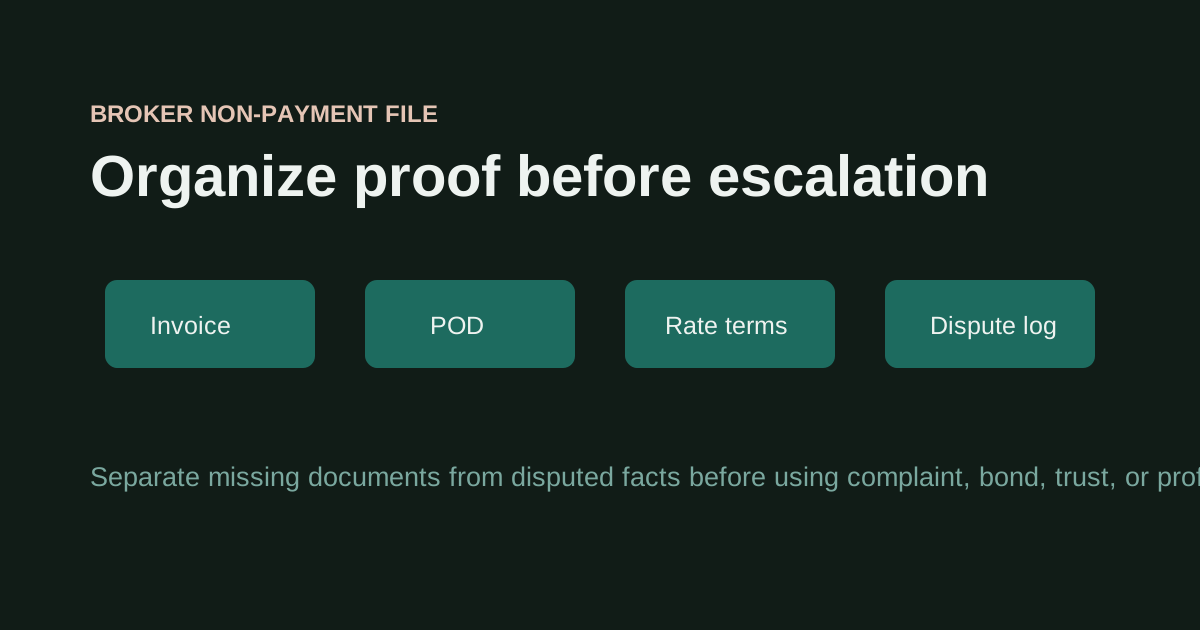
- Keep the rate confirmation, invoice, POD, accessorial approval, and payment terms together.
- Verify payment-direction changes through a known contact before updating instructions.
- Preserve factoring notices, NOAs, remittance emails, and dispute messages.
- Use official complaint and bond or trust resources only after the document trail is organized.
When quick-pay instructions require independent verification
Quick pay is a standard feature at many brokerages and is entirely legitimate when offered on agreed terms. The problem appears when quick-pay instructions arrive outside the original rate confirmation process — through a different contact, with urgency, or with changed banking details that weren't in the carrier packet or agreement. FBI IC3 tracks payment redirection fraud — where instructions to send payment to a different account arrive through email or portal messages — as part of its business email compromise reporting, and freight-specific quick-pay redirection appears in FMCSA fraud alerts as a current documented pattern.
A documented quick-pay fraud pattern involves spoofed messages that mimic a broker's quick-pay portal but route payments to a different account. Before following quick-pay instructions, the channel through which they arrived matters as much as the instructions themselves. Instructions that appeared in the original rate confirmation carry more weight than a follow-up email from a slightly different domain.
When quick-pay instructions require independent verification checklist
- Whether quick-pay instructions appeared in the original rate confirmation or arrived through a separate channel
- Whether the contact offering quick pay can be confirmed through the broker's main office number
- Whether any banking details in a quick-pay offer match what was used in prior loads from this broker
- Whether written confirmation of quick-pay terms can be obtained from a confirmed contact
- Whether the fee and timing are consistent with this broker's standard offer
Quick-pay records to check before acting on payment instructions
Payment review starts with the invoice package: rate confirmation, POD, accessorial approvals, payment terms, and any notice of assignment. In this guide, that starts with quick-pay terms, banking changes, urgency, and spoofed payment messages.
The file should distinguish missing paperwork from a disputed fact, because those two problems move through different channels. Keep the question practical: what changed, who introduced it, and which dated record can be saved before anyone acts on it.
Quick-pay records to check before acting on payment instructions checklist
- Keep the rate confirmation, invoice, POD, accessorial approval, and payment terms together.
- Verify payment-direction changes through a known contact before updating instructions.
- Preserve factoring notices, NOAs, remittance emails, and dispute messages.
- Use official complaint and bond or trust resources only after the document trail is organized.
Documentation to preserve when quick-pay instructions arrive
For quick pay red flags, the useful record is usually the one that shows where quick-pay terms, banking changes, urgency, and spoofed payment messages first entered the file.
That record is stronger when it sits beside the dated lookup, the original message, and a note from the accounting, factoring, or dispute contact. It is weaker when it has been renamed, cropped, forwarded without headers, or separated from the transaction timeline.
Documentation to preserve when quick-pay instructions arrive checklist
- Record the name, number, document field, contact path, or instruction tied to quick-pay terms, banking changes, urgency, and spoofed payment messages.
- Keep the original file or message before saving a marked-up copy.
- Add the source URL, access date, sender identity, and who confirmed or contradicted the detail.
Questions that verify a quick-pay instruction before payment moves
Hold the payment, dispute, or remittance decision when the file depends on a new contact path, revised document, missing official record, or mismatch that no one has explained.
The pause should be narrow and written down: the field that does not line up, the source used to check it, and the person or channel that must answer before the work continues.
Questions that verify a quick-pay instruction before payment moves checklist
- Name the exact field or instruction that does not line up.
- Save the document version or message that introduced the mismatch.
- Check the official or independently known source before using the new detail.
- Record the confirmation result before continuing.
What a familiar broker name doesn't confirm about a quick-pay link or form
Payment records should be saved in the order they were created, especially when instructions or factoring details changed midstream. In this guide, that starts with quick-pay terms, banking changes, urgency, and spoofed payment messages.
Keep remittance messages and dispute replies with timestamps so an aging file does not depend on memory. Keep the question practical: what changed, who introduced it, and which dated record can be saved before anyone acts on it.
What a familiar broker name doesn't confirm about a quick-pay link or form checklist
- Invoice and aging notes
- Signed POD or delivery confirmation
- Rate confirmation and accessorial approvals
- NOA, factoring, or payment-assignment records
- Broker accounting emails and dispute messages
When a quick-pay instruction requires an independent callback to confirm
Payment questions should identify which document supports the amount, the payee, and the timing. In this guide, that starts with quick-pay terms, banking changes, urgency, and spoofed payment messages.
When a dispute may involve contract, bond, trust, factoring, or collection issues, the documentation should be organized before professional review. Keep the question practical: what changed, who introduced it, and which dated record can be saved before anyone acts on it.
When a quick-pay instruction requires an independent callback to confirm checklist
- Which rate confirmation supports the invoice?
- What POD or accessorial record is missing?
- Who requested the payment-direction change?
- Which broker entity appears in L&I and payment terms?
Further context on quick-pay risk
Payment risk content must stay inside documentation boundaries. A checklist can prepare a file, but it cannot decide legal rights or recovery options. In this guide, that starts with quick-pay terms, banking changes, urgency, and spoofed payment messages.
Avoid treating silence, delay, or a dispute as proof of fraud without records showing what happened. Keep the question practical: what changed, who introduced it, and which dated record can be saved before anyone acts on it.
Further context on quick-pay risk checklist
- Do not assume non-payment proves fraud.
- Do not assume an NOA answers every payment question.
- Do not assume a bond filing guarantees recovery.
- Do not send private accusations as a substitute for records.
When to move the dispute to the next channel
Move the issue to the next channel when the invoice package is complete enough for a qualified reviewer or official complaint path. In this guide, that starts with quick-pay terms, banking changes, urgency, and spoofed payment messages.
That may involve broker accounting, a factoring contact, a bond or trust process, qualified counsel, or FMCSA channels depending on the facts. Keep the question practical: what changed, who introduced it, and which dated record can be saved before anyone acts on it.
When to move the dispute to the next channel checklist
- Payment is aging past the agreed terms.
- The broker disputes facts not reflected in the file.
- A factoring or NOA conflict affects remittance.
- A bond, trust, complaint, or legal deadline may be involved.
Source Notes
Source context for Quick Pay Red Flags
For payment-risk topics, FMCSA Licensing & Insurance confirms broker authority and financial responsibility (BMC-84 bond or BMC-85 trust). NCCDB is a complaint-tracking system, not a payment-enforcement mechanism. FBI IC3 handles cyber-enabled payment fraud. For payment disputes, the load documentation — invoice, POD, rate confirmation, NOA — supports but does not replace legal or factoring-company review.
FAQ
If a broker portal asks me to re-enter banking details for quick pay, is that a red flag?
Yes. Legitimate quick-pay systems do not typically ask carriers to re-enter banking details through a form after a load is booked. Contact the broker's main accounting line — not a number from the portal — to confirm whether the request is legitimate before entering any information.
Is it safe to use a broker's quick-pay portal if it asks me to re-enter banking details?
Treat any unexpected request to re-enter banking details as a red flag requiring verification through the broker's main accounting line — not through the portal or a number provided by the portal. Legitimate systems don't typically require re-entry of banking details after initial setup. Verify before entering any account information.
What's the difference between quick pay offered in the original rate confirmation and quick pay offered after dispatch?
Quick pay in the original rate confirmation is an agreed-upon term at the time of booking. Quick pay offered after dispatch — especially through a new contact or email — is a change that requires the same verification as any payment instruction change: direct confirmation through a known contact established before the current transaction.
Source References
- Broker and Carrier Fraud and Identity Theft Federal Motor Carrier Safety Administration. primary source. Last checked 2026-06-01. FMCSA guidance on broker and carrier fraud, unauthorized USDOT use, suspicious links, SAFER phone comparison, NCCDB, OIG, FTC, and IC3 reporting pointers.
- Internet Crime Complaint Center Federal Bureau of Investigation. primary source. Last checked 2026-05-15. Official IC3 entry point. Use the official domain directly to reduce spoofed reporting-site risk.