
How this comes up in practice
A small carrier factors an invoice after delivery. Weeks later, the broker disputes payment because the POD is missing a receiver stamp and the rate confirmation in the broker's file names a different remittance party. The factor asks the carrier for the original rate confirmation, POD, invoice, NOA acknowledgment, and every message about payment direction. The carrier assumes the factoring arrangement decides who takes the loss. It does not work that neatly at the desk level. Before anyone can interpret the contract, the records have to show whether the invoice package was complete, whether the broker acknowledged the assignment, and which version of the rate confirmation was used. Recourse language becomes relevant only after the transaction file is organized enough for a qualified reviewer.
What factoring structure changes and what it doesn't
Whether a factoring arrangement is recourse or non-recourse determines who bears the risk when a purchased invoice isn't paid — but it doesn't change what a carrier needs to document for each load. The invoice, BOL, POD, rate confirmation, and approved accessorial records are required under either structure. The factoring agreement governs what happens after a dispute; the underlying load documentation is what makes the agreement enforceable at all. For adjacent verification steps, compare this with Factoring NOA Explained, Broker Non-Payment Checklist, and Broker Credit Check Basics.
In a recourse arrangement, an uncollectible invoice returns to the carrier, which means the carrier's documentation is what protects it if a recourse provision is triggered. In a non-recourse arrangement, the factor takes on that risk for qualifying invoices — but qualification depends on conditions the carrier may not fully control, including the broker's creditworthiness at the time of purchase and compliance with the factor's submission requirements.
The practical implication is that documentation discipline is not optional regardless of factoring type. A carrier who maintains complete load files — rate confirmation, POD, BOL, approved accessorials — is positioned to meet any factoring agreement's submission requirements and to support any dispute that arises, whether the factor absorbs the risk or a recourse provision applies.
Key Takeaways
- Keep the rate confirmation, invoice, POD, accessorial approval, and payment terms together.
- Verify payment-direction changes through a known contact before updating instructions.
- Preserve factoring notices, NOAs, remittance emails, and dispute messages.
- Use official complaint and bond or trust resources only after the document trail is organized.
How factoring terms affect documentation requirements in a dispute
Whether a factoring arrangement is recourse or non-recourse affects what happens when an invoice isn't paid — but it doesn't change the documentation that a carrier needs to maintain for each load. The invoice, BOL, POD, rate confirmation, and any approved accessorial records are required regardless of factoring type.
Where factoring terms matter operationally is in understanding whether a broker non-payment dispute puts financial risk back on the carrier. That determination belongs in the factoring agreement and, in an active dispute, with whoever reviews that agreement on the carrier's behalf. This guide covers the documentation side, not the contractual analysis.
How factoring terms affect documentation requirements in a dispute checklist
- Whether the factoring agreement's recourse terms were reviewed before signing
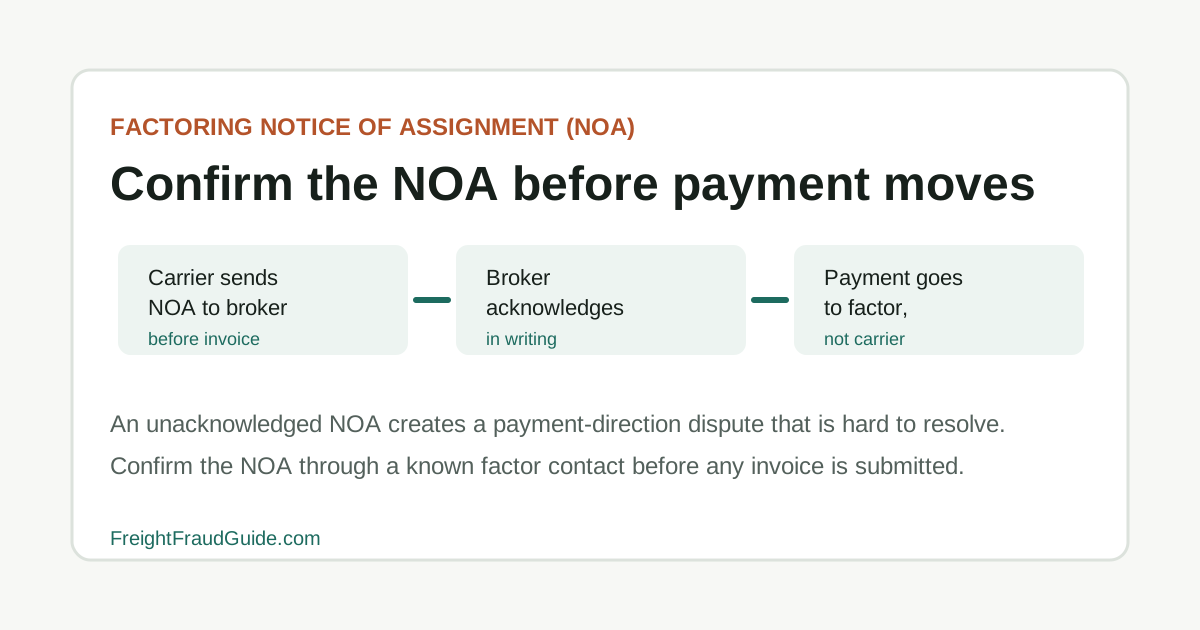
- Whether the NOA was sent to the broker and acknowledged before any invoice was submitted
- Whether each invoice includes the correct factoring entity as payment recipient
- Whether any disputed invoice has its full supporting document set — BOL, POD, rate confirmation — attached
- Whether the factoring company was notified before any dispute reached a legal stage
Payment records to organize first
Payment review starts with the invoice package: rate confirmation, POD, accessorial approvals, payment terms, and any notice of assignment. In this guide, that starts with how factoring terms affect documentation needs without giving financial advice.
The file should distinguish missing paperwork from a disputed fact, because those two problems move through different channels. Keep the question practical: what changed, who introduced it, and which dated record can be saved before anyone acts on it.
Payment records to organize first checklist
- Keep the rate confirmation, invoice, POD, accessorial approval, and payment terms together.
- Verify payment-direction changes through a known contact before updating instructions.
- Preserve factoring notices, NOAs, remittance emails, and dispute messages.
- Use official complaint and bond or trust resources only after the document trail is organized.
What the payment file can show
For recourse vs non-recourse factoring and fraud risk, the useful record is usually the one that shows where how factoring terms affect documentation needs without giving financial advice first entered the file.
That record is stronger when it sits beside the dated lookup, the original message, and a note from the accounting, factoring, or dispute contact. It is weaker when it has been renamed, cropped, forwarded without headers, or separated from the transaction timeline.
What the payment file can show checklist
- Record the name, number, document field, contact path, or instruction tied to how factoring terms affect documentation needs without giving financial advice.
- Keep the original file or message before saving a marked-up copy.
- Add the source URL, access date, sender identity, and who confirmed or contradicted the detail.
When accounting should hold the file
Hold the payment, dispute, or remittance decision when the file depends on a new contact path, revised document, missing official record, or mismatch that no one has explained.
The pause should be narrow and written down: the field that does not line up, the source used to check it, and the person or channel that must answer before the work continues.
When accounting should hold the file checklist
- Name the exact field or instruction that does not line up.
- Save the document version or message that introduced the mismatch.
- Check the official or independently known source before using the new detail.
- Record the confirmation result before continuing.
What to preserve for dispute or escalation
Payment records should be saved in the order they were created, especially when instructions or factoring details changed midstream. In this guide, that starts with how factoring terms affect documentation needs without giving financial advice.
Keep remittance messages and dispute replies with timestamps so an aging file does not depend on memory. Keep the question practical: what changed, who introduced it, and which dated record can be saved before anyone acts on it.
What to preserve for dispute or escalation checklist
- Invoice and aging notes
- Signed POD or delivery confirmation
- Rate confirmation and accessorial approvals
- NOA, factoring, or payment-assignment records
- Broker accounting emails and dispute messages
Questions to answer before escalating
Payment questions should identify which document supports the amount, the payee, and the timing. In this guide, that starts with how factoring terms affect documentation needs without giving financial advice.
When a dispute may involve contract, bond, trust, factoring, or collection issues, the documentation should be organized before professional review. Keep the question practical: what changed, who introduced it, and which dated record can be saved before anyone acts on it.
Questions to answer before escalating checklist
- Which rate confirmation supports the invoice?
- What POD or accessorial record is missing?
- Who requested the payment-direction change?
- Which broker entity appears in L&I and payment terms?
Assumptions that complicate disputes
Payment risk content must stay inside documentation boundaries. A checklist can prepare a file, but it cannot decide legal rights or recovery options. In this guide, that starts with how factoring terms affect documentation needs without giving financial advice.
Avoid treating silence, delay, or a dispute as proof of fraud without records showing what happened. Keep the question practical: what changed, who introduced it, and which dated record can be saved before anyone acts on it.
Assumptions that complicate disputes checklist
- Do not assume non-payment proves fraud.
- Do not assume an NOA answers every payment question.
- Do not assume a bond filing guarantees recovery.
- Do not send private accusations as a substitute for records.
When to move the dispute to the next channel
Move the issue to the next channel when the invoice package is complete enough for a qualified reviewer or official complaint path. In this guide, that starts with how factoring terms affect documentation needs without giving financial advice.
That may involve broker accounting, a factoring contact, a bond or trust process, qualified counsel, or FMCSA channels depending on the facts. Keep the question practical: what changed, who introduced it, and which dated record can be saved before anyone acts on it.
When to move the dispute to the next channel checklist
- Payment is aging past the agreed terms.
- The broker disputes facts not reflected in the file.
- A factoring or NOA conflict affects remittance.
- A bond, trust, complaint, or legal deadline may be involved.
Source Notes
Source context for Recourse vs Non-Recourse Factoring and Fraud Risk
For payment-risk topics, FMCSA Licensing & Insurance confirms broker authority and financial responsibility (BMC-84 bond or BMC-85 trust). NCCDB is a complaint-tracking system, not a payment-enforcement mechanism. FBI IC3 handles cyber-enabled payment fraud. For payment disputes, the load documentation — invoice, POD, rate confirmation, NOA — supports but does not replace legal or factoring-company review.
FAQ
What should I tell my factoring company if a broker disputes an invoice they've already purchased?
Notify your factor immediately with the full documentation: rate confirmation, POD, BOL, invoice, and the broker's dispute in writing. The factoring agreement may specify how disputes are handled — consult it and your factor's procedures before responding to the broker.
Does the factoring arrangement type affect what documents I need for each load?
No — the load documentation requirements are the same either way: rate confirmation, BOL, POD, invoice, and any approved accessorials. What differs is what happens to an unpaid invoice. In a recourse arrangement, the carrier may owe the amount back to the factor. In non-recourse, the factor absorbs the loss under qualifying conditions. Your documentation standard shouldn't change based on the factoring type.
What should I do if my factor declines to purchase a receivable because of the broker's credit?
The factor is exercising their right to decline a receivable they consider uncollectible. You can still move the load and invoice the broker directly without factoring that invoice — taking on the payment risk yourself. Document the factor's decline and the reason; it's relevant context if a payment issue arises later.
Source References
- National Consumer Complaint Database Federal Motor Carrier Safety Administration. primary source. Last checked 2026-05-28. Official FMCSA complaint portal for eligible motor carrier, broker, safety, and registration-related issues.
- Licensing & Insurance Public Federal Motor Carrier Safety Administration. primary source. Last checked 2026-06-02. Official public portal for authority, insurance, and broker financial responsibility records.