
How this comes up in practice
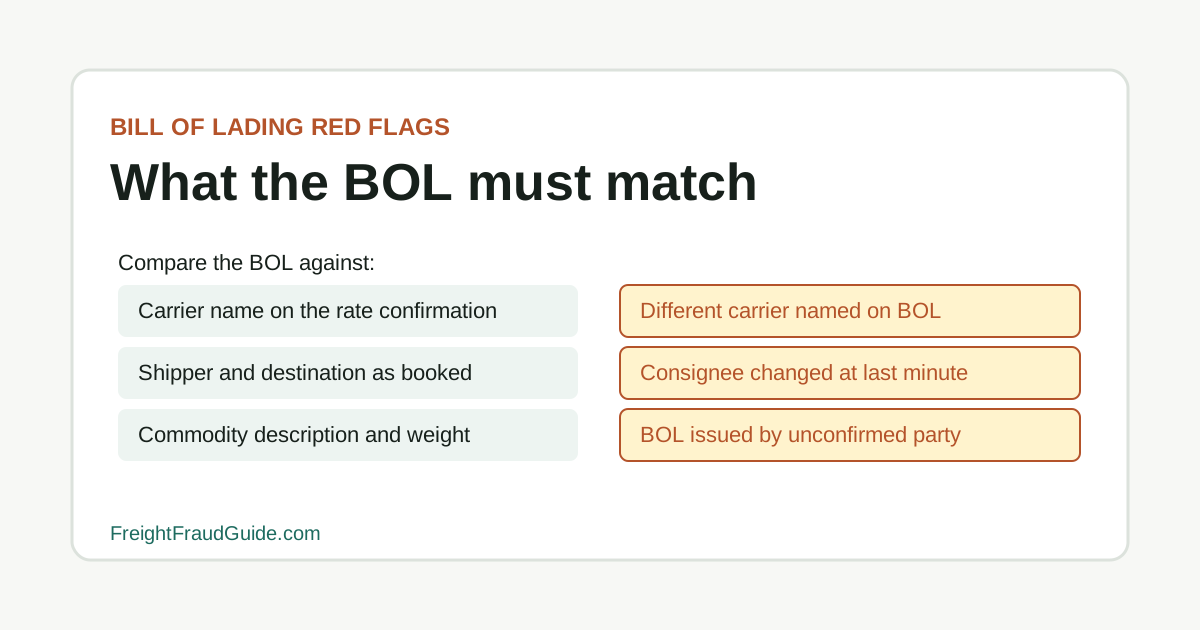
The BOL check that catches the most problems is the one done at pickup, before freight is released. What tends to go unnoticed when the check is skipped: the carrier name on the BOL differs from the carrier named in the rate confirmation. The driver has the correct pickup number, the paperwork appears standard, and the discrepancy only surfaces when the two documents are compared side by side before the truck is loaded. Calling the broker through a known contact — not through the driver — while freight is still at the dock is what produces the information needed to resolve the question. A carrier name mismatch caught at pickup is a documentation question; the same mismatch discovered after delivery is considerably harder to address.
The BOL as a custody record, not just a shipping document
A bill of lading establishes a custody record: who released the freight, to which carrier, for delivery to which receiver. In a clean transaction, the BOL is a formality. In a disputed transaction, it's often the single most important document — and the most revealing one, because what the BOL says about the carrier and the seal at pickup is either consistent with the rest of the transaction record or it isn't. For adjacent verification steps, compare this with Shipper-Broker-Carrier Document Trail, Seal Number Checklist, and Pickup Verification Checklist.
BOL red flags tend to appear in specific fields: the carrier name, the seal number, the commodity description, and the shipper's release signature. A carrier name that doesn't match the rate confirmation, a seal that's missing or different, or a commodity listed differently than the original description are discrepancies that have innocent explanations in some cases and significant implications in others.
The review that catches most BOL problems is a side-by-side comparison with the rate confirmation before the driver leaves the dock. That comparison takes a few minutes at pickup and is significantly easier than reconstructing what happened after the freight has moved.
Key Takeaways
- BOL
- Rate confirmation
- Pickup photos if permitted
- Seal record
- Driver/equipment note
- POD
What to check on the BOL at pickup
Review the BOL at pickup and delivery against the rate confirmation and carrier assignment.
A BOL mismatch can affect cargo custody, payment, and incident response.
What to check on the BOL at pickup checklist
- Compare carrier name.
- Record seal number.
- Check pickup and delivery signatures.
BOL records to preserve through delivery
For this workflow, build the file around bol and rate confirmation. Keep the first version separate from later corrections so the sequence remains clear.
BOL records to preserve through delivery checklist
- BOL
- Rate confirmation
- Pickup photos if permitted
- Seal record
- Driver/equipment note
- POD
BOL signals worth stopping to verify
Treat "Carrier name mismatch" as a reason to slow the transaction and document a call-back. It is not, by itself, a public accusation or final finding.
BOL signals worth stopping to verify checklist
- Carrier name mismatch
- Blank shipper or receiver fields
- Seal missing or changed
- Commodity vague or inconsistent
- Signature or date missing
Questions the BOL should answer
Start with the question "Who released the freight?" and tie the answer to a record, known contact, or dated instruction.
Questions the BOL should answer checklist
- Who released the freight?
- Which carrier was expected?
- What seal was applied?
- Who accepted delivery?
- Were exceptions written down?
What a clean BOL doesn't confirm
The main trap here is assuming too much from an incomplete file. In particular: Do not assume BOL errors are clerical without checking.
What a clean BOL doesn't confirm checklist
- Do not assume BOL errors are clerical without checking.
- Do not assume a clean POD fixes pickup mismatches.
- Do not assume photos can replace required documents.
Official records to compare the BOL against
Use FBI cargo theft guidance for custody risk as a comparison point and save the lookup date. Official status can change, and legitimate company records can be impersonated.
Official records to compare the BOL against checklist
- FBI cargo theft guidance for custody risk
- FMCSA fraud guidance
- SAFER for carrier comparison
When a BOL discrepancy requires escalation
Escalate when the file reaches a concrete unresolved point, such as: BOL names a different carrier. Preserve the evidence and move the question to the right internal, insurance, legal, law-enforcement, or official reporting channel.
When a BOL discrepancy requires escalation checklist
- BOL names a different carrier.
- Seal exception appears.
- Delivery confirmation conflicts with receiver records.
Source Notes
BOL review is a custody check
Use the BOL to compare carrier, driver, commodity, seal, pickup date, delivery, and signature details against the rest of the file.
FAQ
If the carrier name on the BOL differs from the rate confirmation, does that mean double brokering occurred?
It's a mismatch that needs explanation, not a definitive finding. Ask the broker to confirm which carrier is authorized and verify through that carrier's management. Document the explanation. Escalate if neither party can confirm authorization.
Can a BOL be corrected after pickup if a name or detail was entered incorrectly?
Corrections to a BOL after pickup create a revised document that differs from the original. Keep both versions separately. A correction that changes the carrier name or commodity description warrants independent confirmation from both the broker and carrier — not just acceptance as a clerical fix. Those are the fields most relevant to authorization and cargo claims.
Who is responsible for verifying the BOL is accurate at pickup?
The shipper controls the facility and the release decision. The broker controls the carrier assignment. The carrier's driver confirms the load. All three have a stake in accuracy. In practice, the shipper is the last checkpoint before freight leaves — if the carrier name on the BOL doesn't match the dispatch record, that's the moment to hold.
Source References
- Cargo Theft Federal Bureau of Investigation. primary source. Last checked 2026-05-15. FBI overview of cargo theft, including strategic theft trends such as identity theft, fictitious pickup, account takeover, double brokering scams, and fraudulent carriers.
- Broker and Carrier Fraud and Identity Theft Federal Motor Carrier Safety Administration. primary source. Last checked 2026-06-01. FMCSA guidance on broker and carrier fraud, unauthorized USDOT use, suspicious links, SAFER phone comparison, NCCDB, OIG, FTC, and IC3 reporting pointers.
- SAFER Company Snapshot Federal Motor Carrier Safety Administration. primary source. Last checked 2026-06-03. Official Company Snapshot lookup. Treat as a current record check, not a guarantee of transaction authority.