
How this comes up in practice
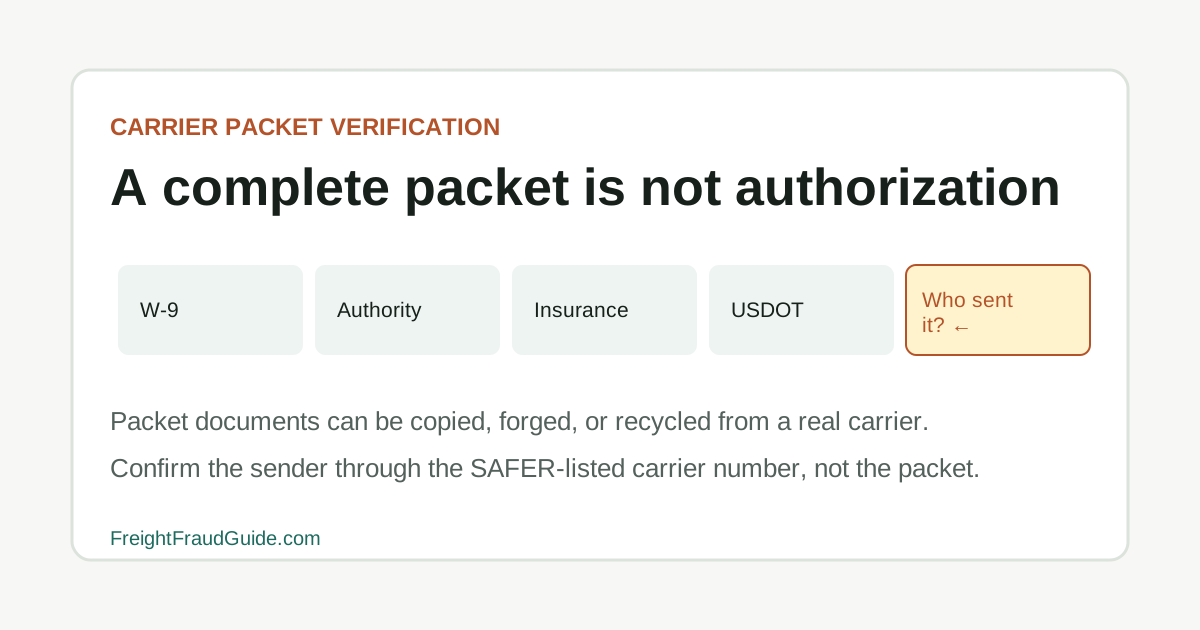
A load moves, the receiver confirms delivery, and two weeks later the carrier calls asking why payment went to a dispatch company they severed ties with three months ago. The rate confirmation named the right carrier; the MC number checked out in SAFER; the insurance certificate matched the carrier's registered entity. The dispatcher had documents from a prior arrangement with the carrier — a packet that was never formally revoked because the carrier didn't know there was anything to revoke. The broker had verified the carrier's authority and insurance, both of which were legitimate. What no one verified was whether this specific dispatcher was still authorized to act for this specific carrier on this load. That verification is a call to the carrier's main management line — reached through SAFER, not through the dispatcher — asking whether the current load was dispatched through them and whether the named dispatch company still has authority to collect on their behalf. The carrier's answer would have been no. The check costs a few minutes; the payment dispute cost considerably more.
Key Takeaways
- Treat the load board post as a lead, not as verification.
- Confirm the broker or carrier identity through official and independently known records.
- Review the email domain, rate, pickup timing, and packet request before sending documents.
- Save screenshots of the posting and all messages before details disappear or change.
What to preserve when a dispatcher is the sole contact for a load
For dispatcher scam red flags, the useful record is usually the one that shows where dispatcher authority, carrier permission, document access, and contact verification first entered the file.
That record is stronger when it sits beside the dated lookup, the original message, and a note from the posting account owner or independently confirmed company contact. It is weaker when it has been renamed, cropped, forwarded without headers, or separated from the transaction timeline.
What to preserve when a dispatcher is the sole contact for a load checklist
- Record the name, number, document field, contact path, or instruction tied to dispatcher authority, carrier permission, document access, and contact verification.
- Keep the original file or message before saving a marked-up copy.
- Add the source URL, access date, sender identity, and who confirmed or contradicted the detail.
Questions that confirm carrier management dispatched this specific load
Hold the booking, dispatch, pickup, or payment decision when the file depends on a new contact path, revised document, missing official record, or mismatch that no one has explained.
The pause should be narrow and written down: the field that does not line up, the source used to check it, and the person or channel that must answer before the work continues.
Questions that confirm carrier management dispatched this specific load checklist
- Name the exact field or instruction that does not line up.
- Save the document version or message that introduced the mismatch.
- Check the official or independently known source before using the new detail.
- Record the confirmation result before continuing.
When a dispatcher-only thread requires a SAFER callback before proceeding
Load board questions should verify the party behind the account before documents or pickup details are shared. In this guide, that starts with dispatcher authority, carrier permission, document access, and contact verification.
A strong answer comes through a known company contact, not through the same profile that created the concern. Keep the question practical: what changed, who introduced it, and which dated record can be saved before anyone acts on it.
When a dispatcher-only thread requires a SAFER callback before proceeding checklist
- Who controls the posting account?
- Does the email domain match the known company domain?
- Can the broker or carrier confirm the posting independently?
- Why is the rate, timing, or packet request unusual?
Further context on dispatcher scam patterns
A marketplace profile can be compromised or reused. Treat reputation signals as context, not identity proof. In this guide, that starts with dispatcher authority, carrier permission, document access, and contact verification.
When a posting feels unusually urgent or generous, slow down enough to preserve the evidence and verify the entity. Keep the question practical: what changed, who introduced it, and which dated record can be saved before anyone acts on it.
Further context on dispatcher scam patterns checklist
- Do not assume a load board account proves identity.
- Do not send packet documents before confirmation.
- Do not assume a high rate is harmless.
- Do not move to a new thread without preserving the original.
When the posting warrants a report
Escalate when the posting identity cannot be confirmed or when the account appears to be part of spoofing, phishing, or identity misuse. In this guide, that starts with dispatcher authority, carrier permission, document access, and contact verification.
Use platform reporting, known company contacts, IC3, FTC, or FMCSA resources according to the facts and the records you saved. Keep the question practical: what changed, who introduced it, and which dated record can be saved before anyone acts on it.
When the posting warrants a report checklist
- The account contact denies a call-back through known records.
- The domain or payment path changes unexpectedly.
- The post requests sensitive packet details before verification.
- The pattern suggests account takeover, spoofing, or identity misuse.
Source Notes
Source context for Dispatcher Scam Red Flags
For load-board scam topics, FMCSA L&I confirms broker authority and entity identity behind a posting. SAFER confirms carrier status. FBI IC3 handles cyber-enabled fraud including email spoofing, account takeovers, and domain lookalike schemes targeting load board users. Load board platform verification is a starting point — not a substitute for independent official-record checks.
FAQ
How do I tell if a dispatcher is legitimate versus someone using a carrier's stolen documents?
Ask for a direct contact at the carrier's management — a main office number you can confirm through SAFER. Call that number independently and ask carrier management to confirm the dispatcher's name and the current load. A legitimate dispatcher welcomes this step.
Is there an FMCSA registration for dispatch services?
Dispatch services generally operate on behalf of a carrier that holds its own FMCSA authority — there's no specific FMCSA license for dispatchers. The verification check that matters is whether the carrier's management confirms this dispatcher's authorization for this specific load, not whether the dispatcher has independent FMCSA registration.
What happens to a legitimate carrier if a dispatcher uses their credentials to book unauthorized loads?
The carrier may become a victim of identity misuse and face disputes over loads they didn't authorize. The appropriate responses include reporting unauthorized use of their USDOT number to FMCSA and law enforcement, notifying load boards where the activity occurred, and alerting any broker or shipper who may have received contact from the unauthorized dispatcher.
Source References
- Broker and Carrier Fraud and Identity Theft Federal Motor Carrier Safety Administration. primary source. Last checked 2026-06-01. FMCSA guidance on broker and carrier fraud, unauthorized USDOT use, suspicious links, SAFER phone comparison, NCCDB, OIG, FTC, and IC3 reporting pointers.
- SAFER Company Snapshot Federal Motor Carrier Safety Administration. primary source. Last checked 2026-06-03. Official Company Snapshot lookup. Treat as a current record check, not a guarantee of transaction authority.