
How this comes up in practice
A load board posting offers $4.20 per mile for a lane where the carrier's usual rate runs closer to $2.80. The broker MC number is active in L&I. The posting has been up for two hours. When the carrier calls the contact number, they're told the shipper has urgent capacity needs and the load will be reposted if not confirmed within thirty minutes. The carrier signs the rate confirmation — which lists the shipper as a holding company name they don't recognize — and sends their packet. No pickup appointment is produced. When the carrier calls back two days later, the phone number in the posting routes to no one familiar with the load, and the MC number belongs to a company that denies posting that lane. The carrier's packet is now in someone else's possession. The above-market rate served its purpose: enough urgency to compress the verification steps that would have surfaced the mismatch before the packet went out. A rate that stands out from market context isn't a signal by itself — markets move and brokers post premium rates for difficult lanes and short-notice capacity. It becomes a concern when it arrives alongside time pressure that discourages the callback confirming whether the contact behind the posting is who the posting claims.
What an above-market rate signals versus what it establishes
An above-market rate by itself is not a fraud signal. Markets move, capacity tightens in specific lanes, and brokers do offer premium rates for short-notice capacity, difficult lanes, or high-value freight that requires extra verification steps. A carrier who declines every rate above market will miss legitimate loads. The issue is not the rate; it's the rate combined with the conditions attached to accepting it. For adjacent verification steps, compare this with Load Board Scam Red Flags, and Broker Payment History Red Flags.
The conditions that turn an above-market rate into a verification concern are specific: urgency that discourages standard verification steps, missing load details that would ordinarily be confirmed before booking, contact information reachable only through the current posting, or resistance to a callback to the broker's FMCSA-listed number. None of those conditions are incompatible with a legitimate load — but each makes independent verification harder, which is precisely why they appear together in fraudulent postings.
The verification workflow this guide describes is the same one that applies to any unfamiliar posting, regardless of rate. The above-market rate is a reason to apply the workflow, not to skip it. A broker posting a genuine high-rate load can confirm their identity through their FMCSA-listed number and provide missing load details without difficulty. The rate is a signal worth noting when something in the posting makes that confirmation harder to complete.
Key Takeaways
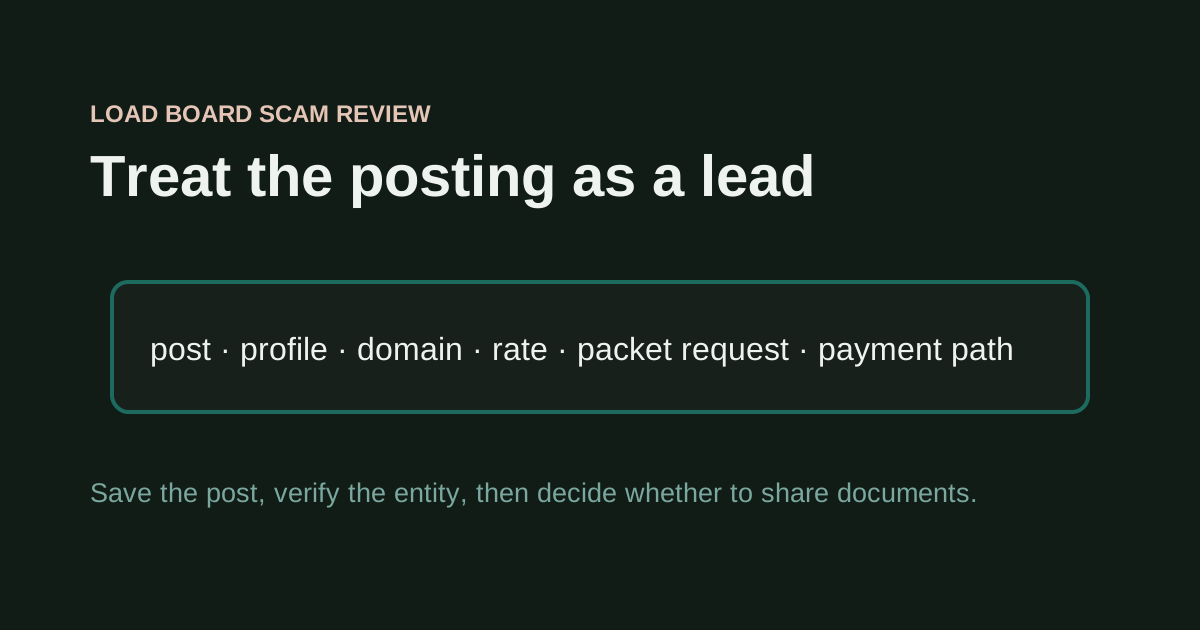
- Treat the load board post as a lead, not as verification.
- Confirm the broker or carrier identity through official and independently known records.
- Review the email domain, rate, pickup timing, and packet request before sending documents.
- Save screenshots of the posting and all messages before details disappear or change.
When an above-market rate is a reason for extra verification steps
An unusually high rate is not proof of fraud. Markets move, lanes tighten, and brokers do post loads above prevailing rates for difficult lane, high-value cargo, or short pickup windows. The concern is when the high rate arrives alongside other signals: urgency without explanation, minimal load details, a new or slightly different email domain, or resistance to standard verification steps.
The combination of signals matters, not the rate in isolation. A broker who posts a high rate and welcomes a call-back through their known office line is handling it transparently. A broker who posts a high rate, discourages call-backs, and asks for driver and equipment details before confirming basic load information is showing a different pattern.
When an above-market rate is a reason for extra verification steps checklist
- Whether the broker MC number matches the rate confirmation entity in L&I
- Whether the contact can be confirmed through a SAFER number or previously established records
- Whether the pickup and shipper details are specific and consistent with a real, bookable load
- Whether any urgency is explained by a plausible business reason or simply asserted
- Whether the original posting and all communications are saved before proceeding
Records to verify before responding to a post
Load board review treats the post as a lead that still needs identity verification. In this guide, that starts with rate spikes, rushed booking, missing details, and pressure to ignore mismatches.
Capture the account, posting details, rate, lane, domain, and packet request before the post is edited or removed. Keep the question practical: what changed, who introduced it, and which dated record can be saved before anyone acts on it.
Records to verify before responding to a post checklist
- Treat the load board post as a lead, not as verification.
- Confirm the broker or carrier identity through official and independently known records.
- Review the email domain, rate, pickup timing, and packet request before sending documents.
- Save screenshots of the posting and all messages before details disappear or change.
What the posting record can show
For too-good-to-be-true rate signals, the useful record is usually the one that shows where rate spikes, rushed booking, missing details, and pressure to ignore mismatches first entered the file.
That record is stronger when it sits beside the dated lookup, the original message, and a note from the posting account owner or independently confirmed company contact. It is weaker when it has been renamed, cropped, forwarded without headers, or separated from the transaction timeline.
What the posting record can show checklist
- Record the name, number, document field, contact path, or instruction tied to rate spikes, rushed booking, missing details, and pressure to ignore mismatches.
- Keep the original file or message before saving a marked-up copy.
- Add the source URL, access date, sender identity, and who confirmed or contradicted the detail.
When not to answer the posting yet
Hold the booking, dispatch, pickup, or payment decision when the file depends on a new contact path, revised document, missing official record, or mismatch that no one has explained.
The pause should be narrow and written down: the field that does not line up, the source used to check it, and the person or channel that must answer before the work continues.
When not to answer the posting yet checklist
- Name the exact field or instruction that does not line up.
- Save the document version or message that introduced the mismatch.
- Check the official or independently known source before using the new detail.
- Record the confirmation result before continuing.
What to save from the posting and thread
Save screenshots early because load board details and message threads can disappear after the other party changes course. In this guide, that starts with rate spikes, rushed booking, missing details, and pressure to ignore mismatches.
The useful file shows how the posting identity connected, or failed to connect, to the broker or carrier records behind it. Keep the question practical: what changed, who introduced it, and which dated record can be saved before anyone acts on it.
What to save from the posting and thread checklist
- Load board posting screenshot
- Profile or account details
- Message thread and email headers when available
- Rate confirmation and packet request
- Official broker or carrier lookup results
Questions that verify the posting identity
Load board questions should verify the party behind the account before documents or pickup details are shared. In this guide, that starts with rate spikes, rushed booking, missing details, and pressure to ignore mismatches.
A strong answer comes through a known company contact, not through the same profile that created the concern. Keep the question practical: what changed, who introduced it, and which dated record can be saved before anyone acts on it.
Questions that verify the posting identity checklist
- Who controls the posting account?
- Does the email domain match the known company domain?
- Can the broker or carrier confirm the posting independently?
- Why is the rate, timing, or packet request unusual?
Assumptions that lead to packet exposure
A marketplace profile can be compromised or reused. Treat reputation signals as context, not identity proof. In this guide, that starts with rate spikes, rushed booking, missing details, and pressure to ignore mismatches.
When a posting feels unusually urgent or generous, slow down enough to preserve the evidence and verify the entity. Keep the question practical: what changed, who introduced it, and which dated record can be saved before anyone acts on it.
Assumptions that lead to packet exposure checklist
- Do not assume a load board account proves identity.
- Do not send packet documents before confirmation.
- Do not assume a high rate is harmless.
- Do not move to a new thread without preserving the original.
When the posting warrants a report
Escalate when the posting identity cannot be confirmed or when the account appears to be part of spoofing, phishing, or identity misuse. In this guide, that starts with rate spikes, rushed booking, missing details, and pressure to ignore mismatches.
Use platform reporting, known company contacts, IC3, FTC, or FMCSA resources according to the facts and the records you saved. Keep the question practical: what changed, who introduced it, and which dated record can be saved before anyone acts on it.
When the posting warrants a report checklist
- The account contact denies a call-back through known records.
- The domain or payment path changes unexpectedly.
- The post requests sensitive packet details before verification.
- The pattern suggests account takeover, spoofing, or identity misuse.
Source Notes
Source context for Too-Good-To-Be-True Rate Signals
For load-board scam topics, FMCSA L&I confirms broker authority and entity identity behind a posting. SAFER confirms carrier status. FBI IC3 handles cyber-enabled fraud including email spoofing, account takeovers, and domain lookalike schemes targeting load board users. Load board platform verification is a starting point — not a substitute for independent official-record checks.
FAQ
If the rate is high but the broker's MC number checks out, should I still be cautious?
Yes. A matching MC number and an above-market rate together do not confirm the contact is legitimate. Confirm the load through the broker's official phone number from SAFER. If the broker avoids a call-back, that's the pattern worth noting.
Are there market conditions where a significantly above-market rate is legitimate?
Yes — lane surges, weather disruptions, equipment shortages, and urgent shipper needs can produce rates well above typical conditions. The concern isn't the rate level alone but whether it arrives alongside other signals: unusual urgency, missing load details, resistance to a callback, or a slightly-off email domain. The rate is context; the combination is what matters.
What should I do if I've already accepted a load at an unusually high rate and now have concerns?
Before dispatch, call the broker through their main number in SAFER or a prior confirmed contact — not through the current email thread — to confirm the load is real. If you can't reach a verified contact, document the attempt. If freight hasn't moved yet, the situation is still manageable. If pickup has already occurred, treat it as a priority verification situation.
Source References
- Broker and Carrier Fraud and Identity Theft Federal Motor Carrier Safety Administration. primary source. Last checked 2026-06-01. FMCSA guidance on broker and carrier fraud, unauthorized USDOT use, suspicious links, SAFER phone comparison, NCCDB, OIG, FTC, and IC3 reporting pointers.
- Fraud Alerts Federal Motor Carrier Safety Administration. primary source. Last checked 2026-06-04. FMCSA alert page for phishing attempts, spoofed portals, fake notices, SAFER impersonation, and registration-related scams.