
How this comes up in practice
The payment dispute scenario that most often turns on missing documentation: the carrier has the POD with the receiver's signature, the invoice is correct, but the record showing when and to whom the delivery confirmation was submitted isn't in the file. The email thread was archived, the account closed, or the message wasn't preserved outside the email client. The document that makes the submission verifiable isn't the POD itself — it's the transmission record. Keeping an unedited copy of the submission email alongside the rate confirmation, BOL, and POD in a shared folder labeled with the load number is what makes the file usable if a dispute arises weeks or months later.
Why pre-pickup preservation is different from routine recordkeeping
Most recordkeeping happens after a transaction completes — the invoice is filed, the delivery confirmation is saved, the load folder is closed. Pre-pickup preservation is different because the records that matter most in a dispute are the ones that existed before freight changed hands, not the ones created afterward. For adjacent verification steps, compare this with Shipper-Broker-Carrier Document Trail, and Pickup Verification Checklist.
A load board posting is what it said at the time you responded to it. A rate confirmation is what it said when you agreed to the load. A FMCSA lookup reflects the carrier's status at the date it was run. None of these are guaranteed to look the same if you return to check them later — postings get edited, documents get revised, profiles change. The preservation that happens before pickup captures the transaction's state at its most important moment.
This is also the preservation step that tends to get skipped, because it requires deliberate action during an active transaction rather than at the end-of-load filing step. Building the pre-pickup file as part of the dispatch process — rather than as a separate task — is the habit that makes it happen consistently.
Key Takeaways
- Load posting
- Rate confirmation
- Broker and carrier records
- Carrier packet
- Insurance certificate
- Pickup number
- Payment terms
- Contact verification notes
What to capture before freight is released
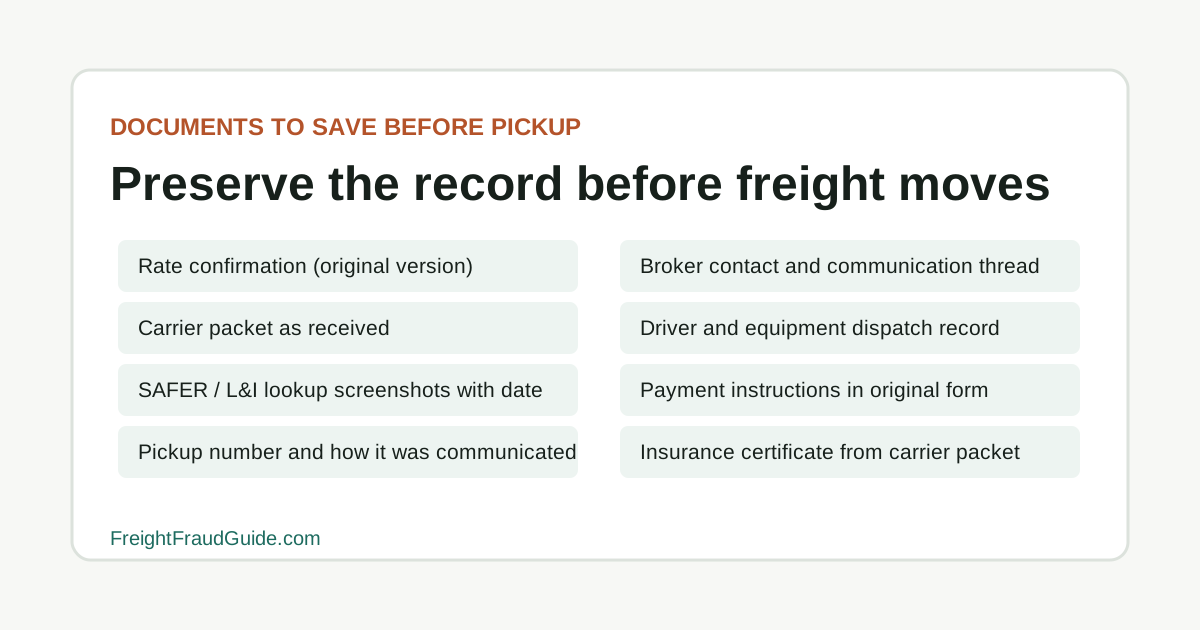
Before pickup, save the documents that show who is authorized, what freight is moving, where it is going, and how payment is supposed to work.
The file should be usable even if a profile or email thread disappears later.
What to capture before freight is released checklist
- Save official lookups.
- Save original PDFs.
- Record call-backs.
Pre-pickup documents to save
For this workflow, build the file around load posting and rate confirmation. Keep the first version separate from later corrections so the sequence remains clear.
Pre-pickup documents to save checklist
- Load posting
- Rate confirmation
- Broker and carrier records
- Carrier packet
- Insurance certificate
- Pickup number
- Payment terms
- Contact verification notes
Pre-pickup documentation gaps worth addressing
Treat "Only screenshots are available" as a reason to slow the transaction and document a call-back. It is not, by itself, a public accusation or final finding.
Pre-pickup documentation gaps worth addressing checklist
- Only screenshots are available
- Pickup number missing
- Official lookup not saved
- Contact changed after dispatch
- Payment instruction not documented
Questions the pre-pickup file should answer
Start with the question "What record proves pickup authority?" and tie the answer to a record, known contact, or dated instruction.
Questions the pre-pickup file should answer checklist
- What record proves pickup authority?
- Who is the known shipper contact?
- Which carrier will arrive?
- What version of the rate confirmation controls?
Pre-pickup documentation assumptions to avoid
The main trap here is assuming too much from an incomplete file. In particular: Do not assume the load board retains old details.
Pre-pickup documentation assumptions to avoid checklist
- Do not assume the load board retains old details.
- Do not assume messages can be recovered later.
- Do not assume the shipper has the same carrier details.
Official records to include before pickup
Use SAFER as a comparison point and save the lookup date. Official status can change, and legitimate company records can be impersonated.
Official records to include before pickup checklist
- SAFER
- L&I
- FMCSA fraud guidance
- FBI cargo theft guidance
When missing pre-pickup documents require escalation
Escalate when the file reaches a concrete unresolved point, such as: Pickup is scheduled but key documents are missing. Preserve the evidence and move the question to the right internal, insurance, legal, law-enforcement, or official reporting channel.
When missing pre-pickup documents require escalation checklist
- Pickup is scheduled but key documents are missing.
- Carrier identity cannot be confirmed.
- A party requests a change without written support.
Source Notes
Pre-pickup files protect the timeline
Save the state of the transaction before freight is released, because postings, profiles, and email threads can change later.
FAQ
Is it too late to start saving documents if pickup has already happened?
No — save what you have as soon as a concern appears. Some records will be unavailable, but rate confirmations, BOLs, email headers, lookup screenshots, and communications from before pickup are still worth collecting. A partial file is better than none for reporting or dispute resolution.
How long should I keep pre-pickup documents after a load completes?
Specific retention periods depend on your company's policies and any applicable regulations or contract terms. As an operational baseline, keeping complete load files for at least the standard window for payment disputes, cargo claims, and bond claim processes — which can involve legal deadlines — is safer than discarding files immediately after delivery.
What if a broker or shipper tells me a particular document isn't needed?
Document that the instruction was given, who gave it, and when. Your decision to proceed without a standard record rests on you, but the record of why it was omitted matters if a dispute arises later. Being told a document isn't needed doesn't eliminate its relevance if a cargo claim or payment dispute requires proof of what was authorized.
Source References
- Broker and Carrier Fraud and Identity Theft Federal Motor Carrier Safety Administration. primary source. Last checked 2026-06-01. FMCSA guidance on broker and carrier fraud, unauthorized USDOT use, suspicious links, SAFER phone comparison, NCCDB, OIG, FTC, and IC3 reporting pointers.
- Cargo Theft Federal Bureau of Investigation. primary source. Last checked 2026-05-15. FBI overview of cargo theft, including strategic theft trends such as identity theft, fictitious pickup, account takeover, double brokering scams, and fraudulent carriers.
- SAFER Company Snapshot Federal Motor Carrier Safety Administration. primary source. Last checked 2026-06-03. Official Company Snapshot lookup. Treat as a current record check, not a guarantee of transaction authority.
- Licensing & Insurance Public Federal Motor Carrier Safety Administration. primary source. Last checked 2026-06-02. Official public portal for authority, insurance, and broker financial responsibility records.