
How this comes up in practice
A carrier submits a delivery confirmation using a photograph of a signed BOL as their POD. The broker's AP team replies that the signature doesn't match the receiver contact on file and the photograph shows no date or facility stamp — just a handwritten signature on a BOL that could have been captured at any point. The carrier knows the delivery happened because the driver reported it. What they cannot produce is a timestamped receiver confirmation from the facility, a delivery receipt showing the location and date, or any record that the specific named receiver contact acknowledged the freight. The dispute goes to the broker's claims team. The POD that would have resolved it was a signed, dated delivery receipt from the receiving facility — not a photograph of a manually signed BOL taken in an indeterminate setting. The gap wasn't in completing the delivery; it was in capturing it with records that answer the questions the AP team was required to ask before releasing payment.
What a POD confirms and where the confirmation gap appears
A proof of delivery is a payment trigger and a custody record. As a payment trigger, it tells the broker that freight arrived and was accepted. As a custody record, it establishes who received the freight, when, and in what condition — information that matters if a cargo claim follows. Both functions depend on the POD containing enough detail to be usable: a date, a named receiver, a facility identification, and a signature tied to a specific person rather than an unmarked mark. For adjacent verification steps, compare this with Broker Non-Payment Checklist, What Documents to Save Before Pickup, and Bill of Lading Red Flags.
The gap that produces payment disputes is not usually a missing signature but a signature the payment processor can't verify. A photograph of a signed BOL taken in a trailer bay confirms that something was signed — not that the right person signed it, at the right facility, at the right time. An AP team that requires a timestamped, facility-stamped delivery receipt is applying a standard that a manual signature photo doesn't meet.
The gap that produces cargo claim disputes is different: a delivery receipt that doesn't note exception conditions. A receiver who accepts freight and signs a clean receipt has implicitly accepted that the freight arrived in satisfactory condition. A receiver who notes visible damage at delivery creates a record that makes the claim's starting point clear. Without that notation, establishing when damage occurred — in transit or at the facility — requires re-creating a record that should have existed at delivery.
Key Takeaways
- Compare every document against the same legal names, identifiers, lane, and shipment details.
- Ask for missing shipper, pickup, delivery, commodity, and payment information before dispatch.
- Save unedited copies of PDFs, emails, texts, call notes, BOLs, PODs, and receipts.
- Document who approved each change and when the approval happened.
What a POD does and doesn't prove about a completed delivery
A POD is only as reliable as the process used to create it. A scan from an unidentified receiver, a photo of a signature block without a timestamp, or a delivery confirmation sent from a different email than the carrier's known contact don't necessarily prove what they appear to prove. They may be genuine records of a completed delivery, or they may reflect a disputed or unauthorized delivery.
For payment, the POD is often the final trigger. For a dispute, it's the first document reviewed. Keeping the original POD and comparing it against the delivery contact and destination shown on the rate confirmation is the baseline check before treating a delivery as confirmed.
What a POD does and doesn't prove about a completed delivery checklist
- Whether the POD shows the receiver name, delivery location, and date consistent with the rate confirmation
- Whether the receiver listed matches the destination and contact named in the original documents
- Whether the POD came from the carrier's own confirmed contact or arrived through a third party
- Whether delivery timing aligns with any available tracking data
- Whether any exception, shortage, or damage was noted before the POD was accepted
Documents to compare across the transaction
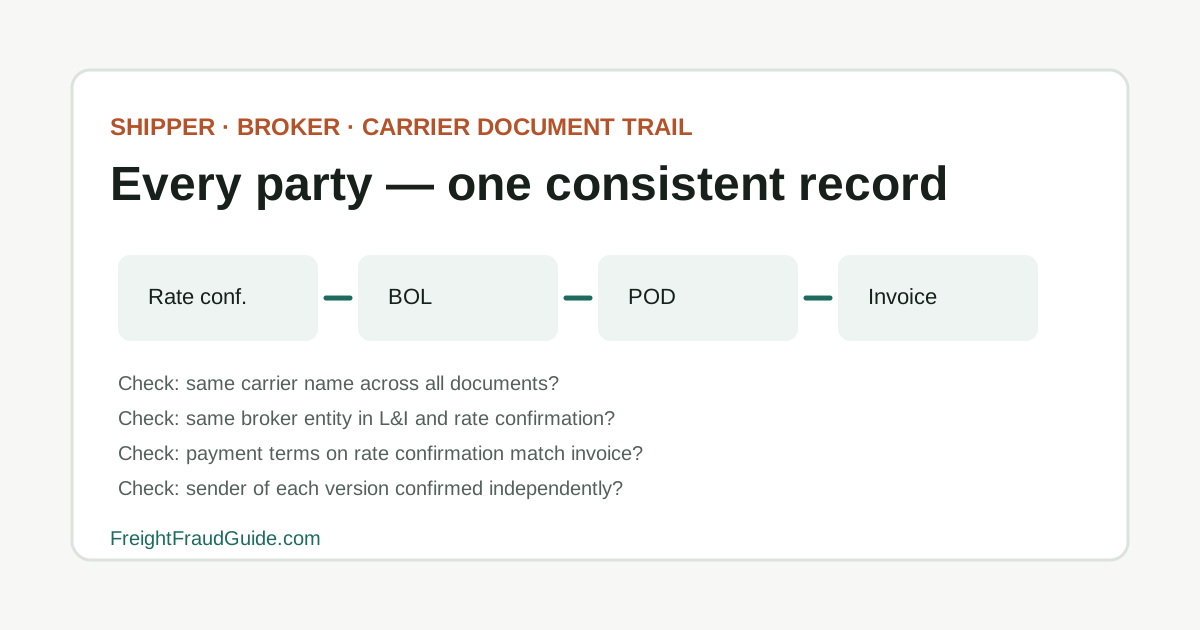
Document review starts by lining up the rate confirmation with the BOL, packet, shipper instructions, lane, commodity, and payment terms. In this guide, that starts with POD timing, receiver details, signatures, photos, and communication records.
The strongest signal is often a change between versions, not the wording of any single PDF. Keep the question practical: what changed, who introduced it, and which dated record can be saved before anyone acts on it.
Documents to compare across the transaction checklist
- Compare every document against the same legal names, identifiers, lane, and shipment details.
- Ask for missing shipper, pickup, delivery, commodity, and payment information before dispatch.
- Save unedited copies of PDFs, emails, texts, call notes, BOLs, PODs, and receipts.
- Document who approved each change and when the approval happened.
What the paperwork can show
For pod and delivery confirmation risk, the useful record is usually the one that shows where POD timing, receiver details, signatures, photos, and communication records first entered the file.
That record is stronger when it sits beside the dated lookup, the original message, and a note from the dispatcher, billing contact, or document reviewer. It is weaker when it has been renamed, cropped, forwarded without headers, or separated from the transaction timeline.
What the paperwork can show checklist
- Record the name, number, document field, contact path, or instruction tied to POD timing, receiver details, signatures, photos, and communication records.
- Keep the original file or message before saving a marked-up copy.
- Add the source URL, access date, sender identity, and who confirmed or contradicted the detail.
When the document set should stop moving
Hold the dispatch, release, invoicing, or document-change decision when the file depends on a new contact path, revised document, missing official record, or mismatch that no one has explained.
The pause should be narrow and written down: the field that does not line up, the source used to check it, and the person or channel that must answer before the work continues.
When the document set should stop moving checklist
- Name the exact field or instruction that does not line up.
- Save the document version or message that introduced the mismatch.
- Check the official or independently known source before using the new detail.
- Record the confirmation result before continuing.
Records to preserve before pickup
Keep original files unedited and preserve revised documents as separate records. In this guide, that starts with POD timing, receiver details, signatures, photos, and communication records.
If a mismatch later matters, the file should show who sent each version, when it arrived, and what instruction changed. Keep the question practical: what changed, who introduced it, and which dated record can be saved before anyone acts on it.
Records to preserve before pickup checklist
- Original and revised rate confirmations
- BOL and pickup instructions
- POD and delivery confirmation
- Accessorial approvals and receipts
- Messages approving document or payment changes
Questions to ask about each document
Document questions should ask who created the instruction and which record supports it. In this guide, that starts with POD timing, receiver details, signatures, photos, and communication records.
The goal is not to debate the PDF; it is to confirm whether the parties, lane, and payment details match the actual shipment. Keep the question practical: what changed, who introduced it, and which dated record can be saved before anyone acts on it.
Questions to ask about each document checklist
- Which document is the controlling version?
- Who approved the changed field?
- Does the carrier named on the paperwork match pickup identity?
- Do payment terms match the broker and invoice record?
Mistakes in document review
A signed document can still contain stale or mismatched information. Signatures do not resolve identity or payment conflicts by themselves. In this guide, that starts with POD timing, receiver details, signatures, photos, and communication records.
Treat document conflicts as a reason to verify through a known channel before freight moves or payment instructions are changed. Keep the question practical: what changed, who introduced it, and which dated record can be saved before anyone acts on it.
Mistakes in document review checklist
- Do not assume the newest PDF is correct.
- Do not assume a signature confirms authority.
- Do not assume missing shipper details can wait.
- Do not merge conflicting document versions.
When a document mismatch requires escalation
Escalate when the document trail no longer identifies the same parties, freight, or payment path. In this guide, that starts with POD timing, receiver details, signatures, photos, and communication records.
Before escalation, save the mismatch plainly so the next reviewer can see the exact field, version, and sender involved. Keep the question practical: what changed, who introduced it, and which dated record can be saved before anyone acts on it.
When a document mismatch requires escalation checklist
- Carrier, broker, or shipper names conflict across records.
- Pickup details change through an unverified channel.
- Payment fields change after dispatch.
- The document mismatch affects release, delivery, or invoicing.
Source Notes
Source context for POD and Delivery Confirmation Risk
For document-review topics, rate confirmations, BOLs, and PODs are private transaction documents — not official records. Official sources like FMCSA L&I and SAFER are used to verify the entities named in those documents, not to validate the documents themselves. Document comparison is the verification step; official records are the reference point.
FAQ
If a POD arrives but the receiver doesn't recognize the signature, what should I do?
Treat it as a disputed delivery and preserve both the POD and the receiver's response. Contact the carrier through a known line for their account of events, and document the timeline. If freight may be missing, escalate to your insurer and, where appropriate, law enforcement.
If a POD is submitted but the broker disputes the delivery, what should I do next?
Confirm delivery details directly with the receiver — who signed, at what time, what the load condition was. If the receiver confirms delivery, send that confirmation to the broker in writing along with the POD. If the receiver doesn't recognize the delivery, treat it as a disputed delivery situation requiring law enforcement and insurer notification.
Does a signed POD guarantee payment?
A signed POD satisfies the delivery proof requirement typically specified in the rate confirmation. Whether it results in payment depends on the broker's financial situation, payment terms, factoring arrangements, and whether the delivery is contested. A POD is a necessary but not always sufficient condition for collection.
Source References
- Cargo Theft Federal Bureau of Investigation. primary source. Last checked 2026-05-15. FBI overview of cargo theft, including strategic theft trends such as identity theft, fictitious pickup, account takeover, double brokering scams, and fraudulent carriers.
- National Consumer Complaint Database Federal Motor Carrier Safety Administration. primary source. Last checked 2026-05-28. Official FMCSA complaint portal for eligible motor carrier, broker, safety, and registration-related issues.